
If you have ever observed a decline in your organic traffic but were unable to find the root cause of the problem, it is very possible that the unnatural links were the culprit.
The point is, identifying the unnatural links, getting rid of them, and establishing the best strategy for your backlink management can easily be done by anyone who owns a website, with proper guidance. After all, when performed correctly, this practice turns into an effective tool for your website rather than a problem.
In this guide, we will explore everything about the issue: from understanding what unnatural links are to dealing with them and preventing them in the future.
What Is an Unnatural Link?
An unnatural link is a type of backlink that is established specifically for the purpose of altering the search engine results and not to assist in making a reader’s experience better.
One must think of what a natural link really is. A food blogger publishes an article about a new recipe and establishes a link to a review of kitchen gadgets. This was done spontaneously and voluntarily without any request or payment.
An unnatural link is the opposite of that. It is placed because of an exchange, a payment, an automated tool, or a scheme, not because it adds any real value.
According to Google’s Search Essentials, any link that is intended to manipulate PageRank or influence rankings in search results may be considered part of a link scheme. That definition is broad on purpose, and it is worth keeping in mind.
Natural Links vs. Unnatural Links: What Is the Difference?
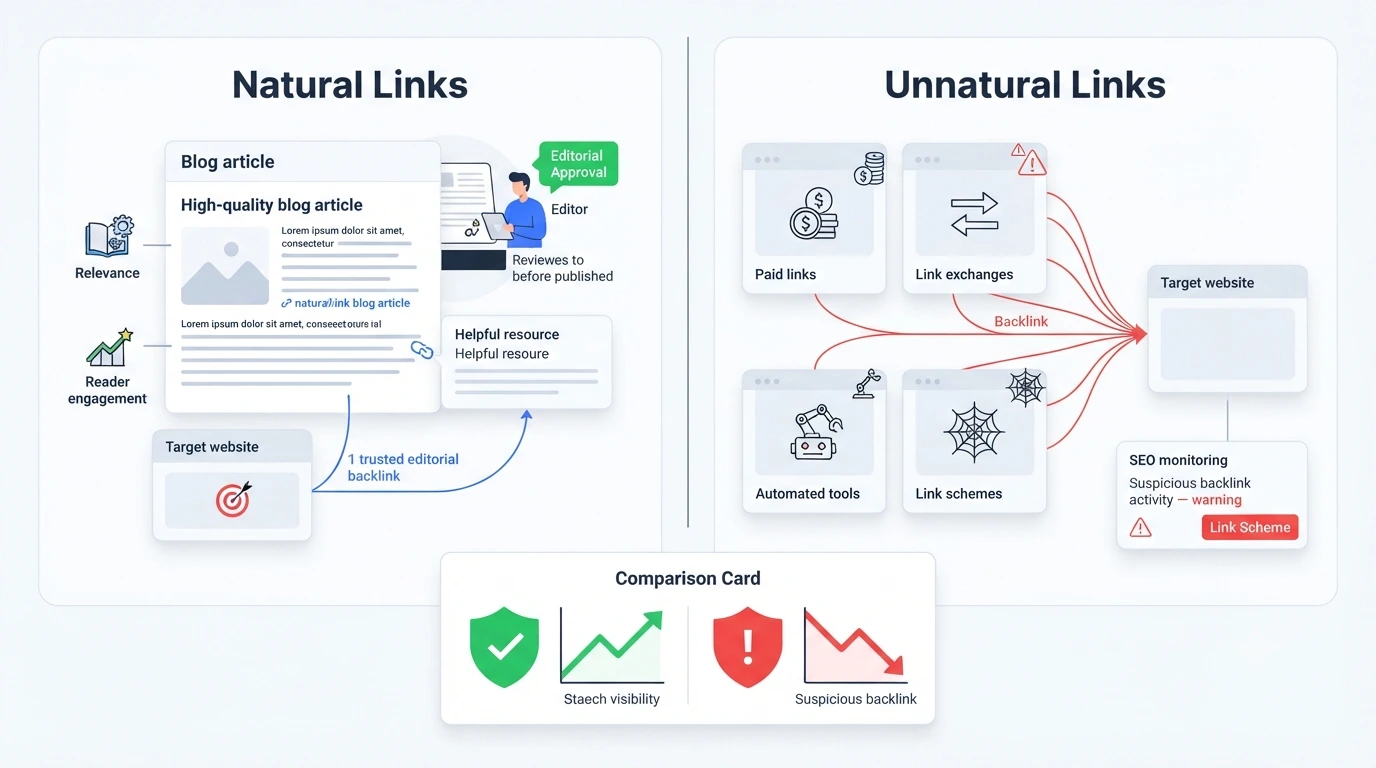
Here is a quick way to think about it:
- Natural link: A website voluntarily links to your content because it is genuinely useful to their readers, with no request or incentive from your side.
- Unnatural link: A link that was placed as part of an exchange, purchase, scheme, or automated process, primarily to influence rankings.
One important note here. Not every proactively built link is automatically unnatural. If you reach out to a relevant, quality website, pitch a genuinely useful piece of content, and earn a contextual placement, that link can look and function just like a naturally earned one. The line gets crossed when quality and relevance stop being the priority.
What Is a Google Penalty?
A Google penalty, also known as a “manual action,” is the process by which Google’s web spam team finds a violation of the Search Essentials Guidelines during an evaluation of your website.
The punishment varies from the demotion of specific pages to complete exclusion from the Google index based on the seriousness and scope of the violation.
How Do You Know If You Have Been Penalized?
Google informs you about any manual action through Google Search Console, and you will receive a manual action notification, which mentions unnatural, artificial, deceptive, and manipulative links pointing to your pages.
Aside from any official manual action, Google could also simply devalue some links algorithmically, and there would be no notification from them. In this situation, you will receive no notification, but you will observe the following:
- Consistent decrease in organic traffic throughout weeks or months
- Previously ranking pages no longer appearing in search results
- New content struggling to get indexed or gain any traction
- Keyword positions dropping across the board without any obvious on-page reason
The good news is that Google does allow sites to recover from penalties, and there is a clear process for doing exactly that.
How Do You Get Unnatural Links?
This is worth understanding clearly, because unnatural links do not always happen on purpose.
You Hired the Wrong Help
One of the most common ways sites end up with a problematic backlink profile is by working with an inexperienced freelancer or low-quality agency that prioritizes volume over quality. Bulk link packages, cheap gig sites, and automated link-building tools are the usual culprits here.
A Previous Owner or Provider Built Them
If you acquired a domain or inherited a site, the backlink profile that came with it may include links built using tactics that are no longer acceptable. This is especially common with older domains.
You Were Targeted by Negative SEO
Yes, competitors or bad actors can deliberately point spammy links at your site to try and trigger a penalty. This is called a negative SEO attack, and while Google has become better at ignoring these, they can still cause harm in certain situations.
You Scaled Up a Tactic Without Guardrails
Guest posts, press releases, directory submissions, and reciprocal links can all be done well. But when any of them are rolled out at high volume with no attention to quality, relevance, or context, they start looking manipulative, and Google notices patterns.
Examples of Unnatural Links
There are quite a few link types that fall into this category. Here are the most important ones to know about:
Private Blog Networks (PBNs)
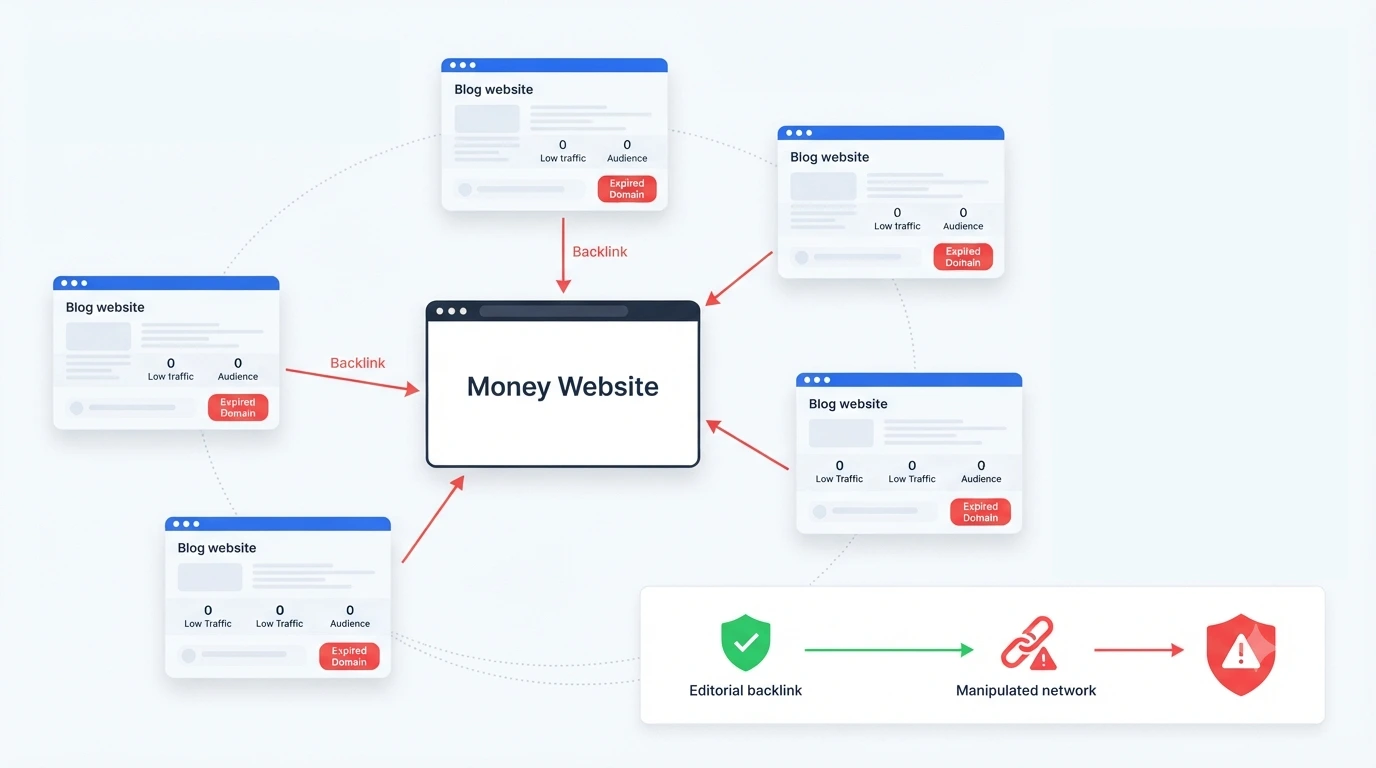
PBNs are networks of websites built specifically to pass link equity to a target site. They tend to have thin content, zero real traffic, and obvious signs of being manufactured. Google has been cracking down on these for years, and the risk of discovery is high.
Link Schemes and Link Exchanges
Organized networks of sites that link to each other in circular patterns purely to pass PageRank are a classic example of link schemes. Reciprocal link exchanges are fine when they happen naturally and involve genuinely relevant sites. When they become coordinated and large-scale, they cross into scheme territory.
Paid Links Without Disclosure
Purchasing a dofollow link on a low-quality website and leaving it without a rel=”sponsored” or rel=”nofollow” tag is a known risk. Sites that sell links openly tend to have poor editorial standards, which means your link ends up in a bad neighborhood.
Sitewide Links
Links that appear in the footer or sidebar of every single page on a website create an unnaturally inflated link count from one domain. One site doing a sitewide link to you is unlikely to cause a problem. A pattern of many sites doing it at once is a different story.
Over-Optimized Anchor Text
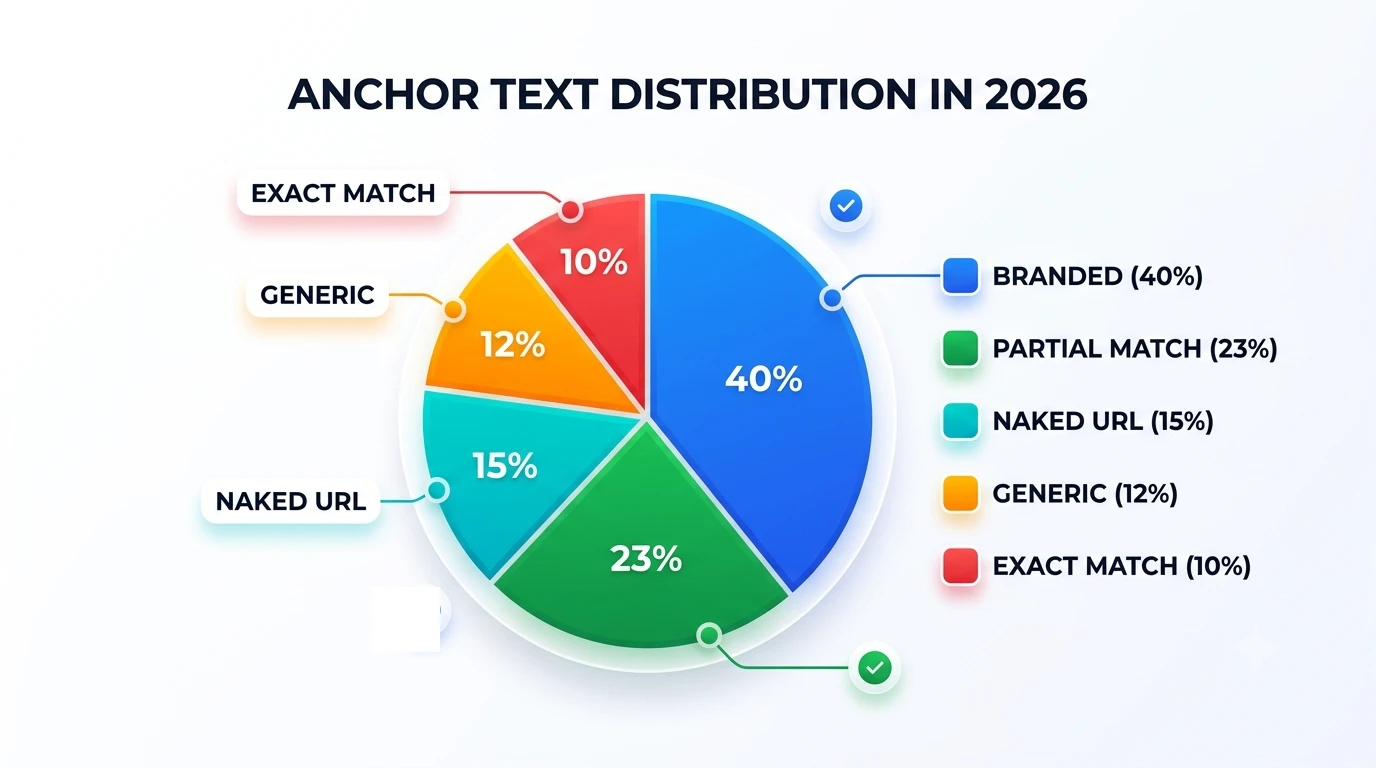
When a large percentage of your backlinks all use the exact same keyword-rich anchor text, it looks engineered rather than organic. A healthy backlink profile contains a natural mix of branded anchors, naked URLs, partial match phrases, and generic text.
Low-Quality Directories and Bookmarking Sites
Legitimate directories that serve real users and organize genuinely useful resources are fine. The ones to avoid are directories built purely to distribute outbound links, with no real audience, no editorial curation, and questionable listings.
Injected Links
Automated software is sometimes used to inject links into other websites by exploiting security vulnerabilities. These are a serious issue both for the site being linked from and for the target site. If you spot a sudden influx of links from completely unrelated hacked sites, this may be what is happening.
Comment Spam and Forum Spam
Automated bots posting links in blog comment sections and forum threads at scale create one of the most visible footprints of unnatural link building. Most forum links are nofollow anyway, but the pattern itself is still a signal.
Spammy Guest Posts
Guest posting on sites with no real audience, no topical relevance, and no editorial standards purely for the link is one of the most common mistakes. The quality of the site you are posting on matters just as much as the content itself.
Press Releases With Over-Optimized Anchors
Press releases are a legitimate communication tool. The issue arises when people pack them with exact-match keyword anchors in an attempt to build links at scale. Stick to branded anchors or naked URLs in press releases to stay on safe ground.
Google’s Rules for Unnatural Links
Google’s position on unnatural links comes through in their Search Essentials documentation clearly. Here are the key things to understand:
- A single unnatural link is unlikely to trigger a manual action. Google is looking for patterns, not isolated instances. One low-quality link in an otherwise healthy profile is not typically cause for alarm.
- Both inbound and outbound links are evaluated. Unnatural links on your site pointing to others can be just as problematic as unnatural links from elsewhere pointing to you.
- Context and relevance matter enormously. Google evaluates whether a link makes logical sense given the content of both the linking page and the page being linked to.
- Anchor text is one of the clearest signals of manipulation. Excessive exact-match anchors across many linking domains is one of the fastest ways to trigger scrutiny.
- Google can act algorithmically without issuing a manual action. This means you may never receive a formal notice, but your links can still be devalued if they look manipulative.
What to Do If You Get an Unnatural Links Penalty?
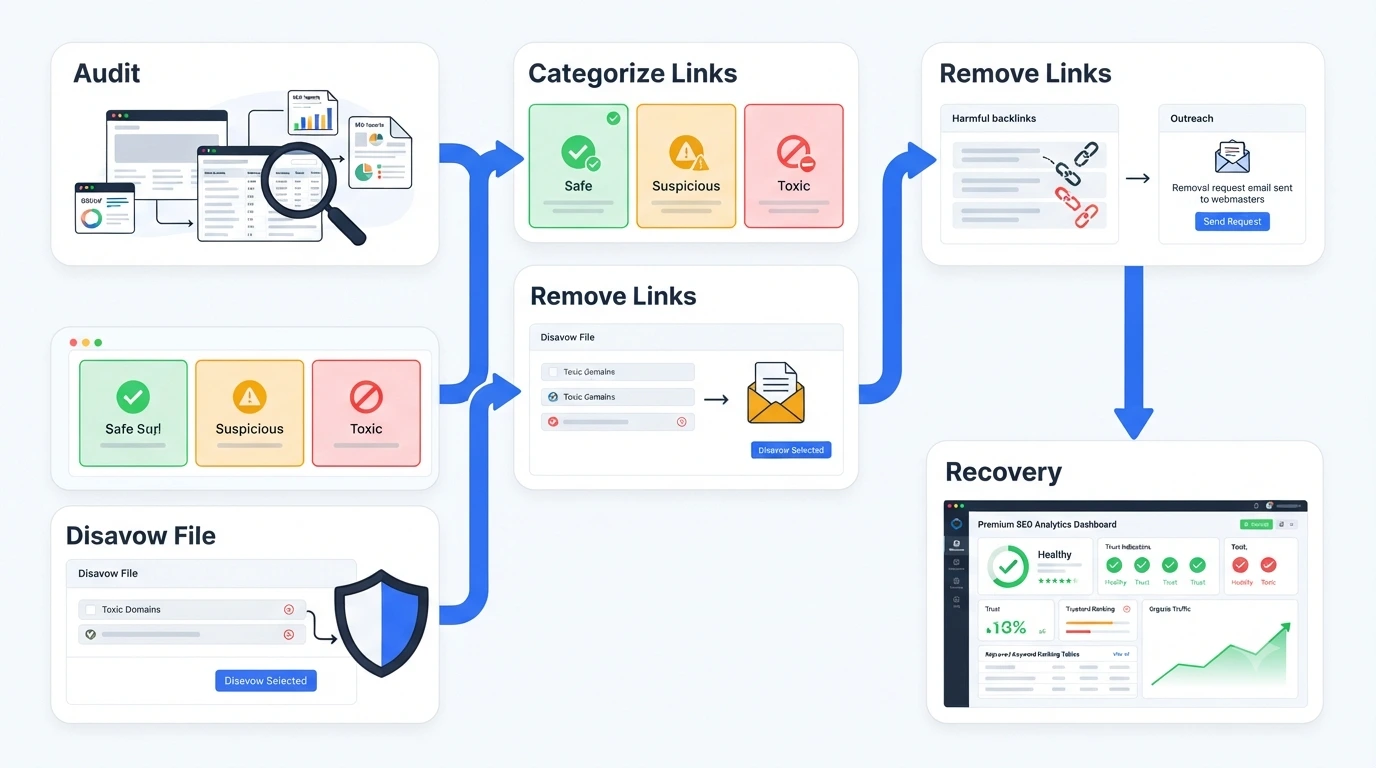
Receiving a manual action is not the end of the road. Here is the process for working through it systematically.
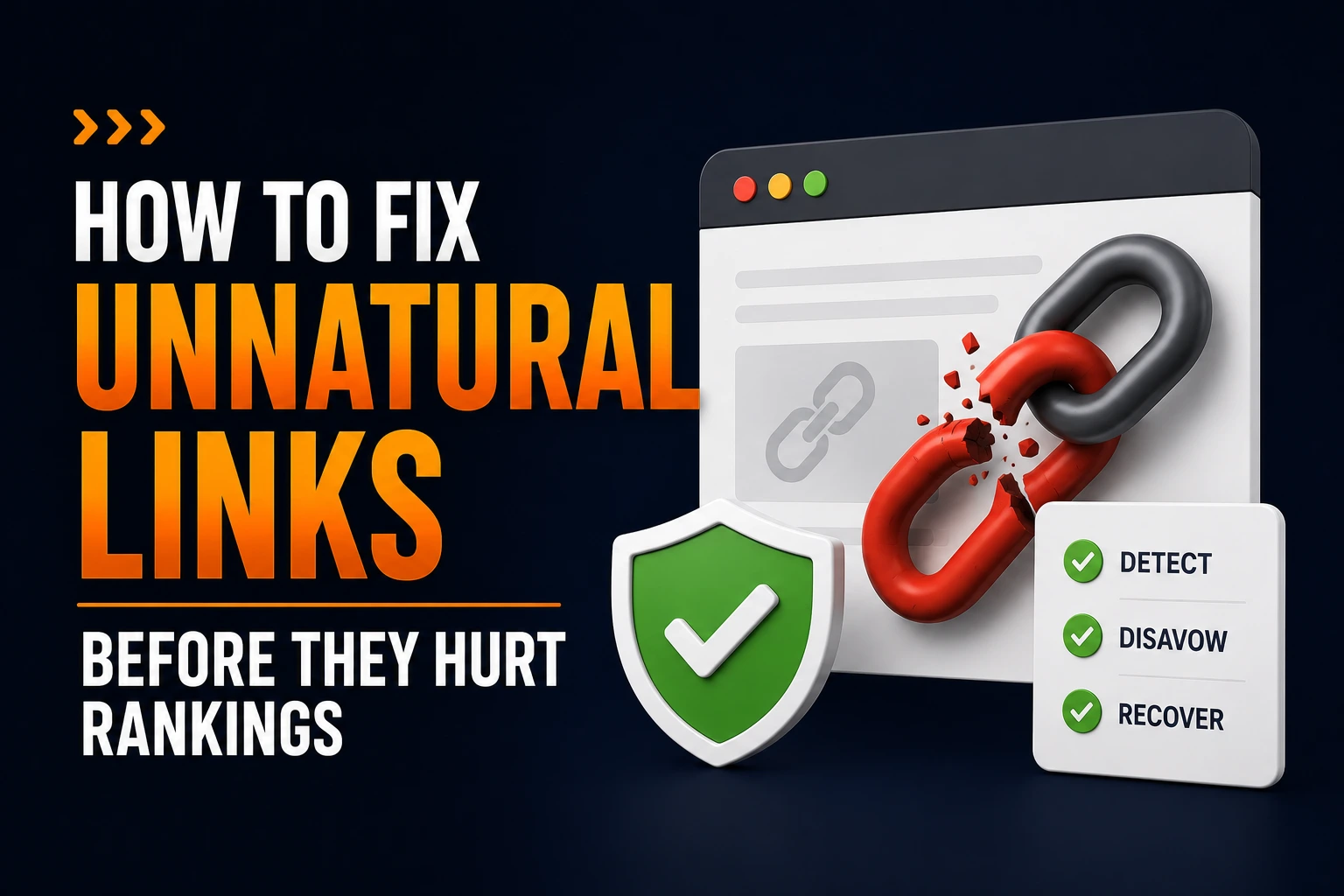
Step 1: Run a Full Backlink Audit
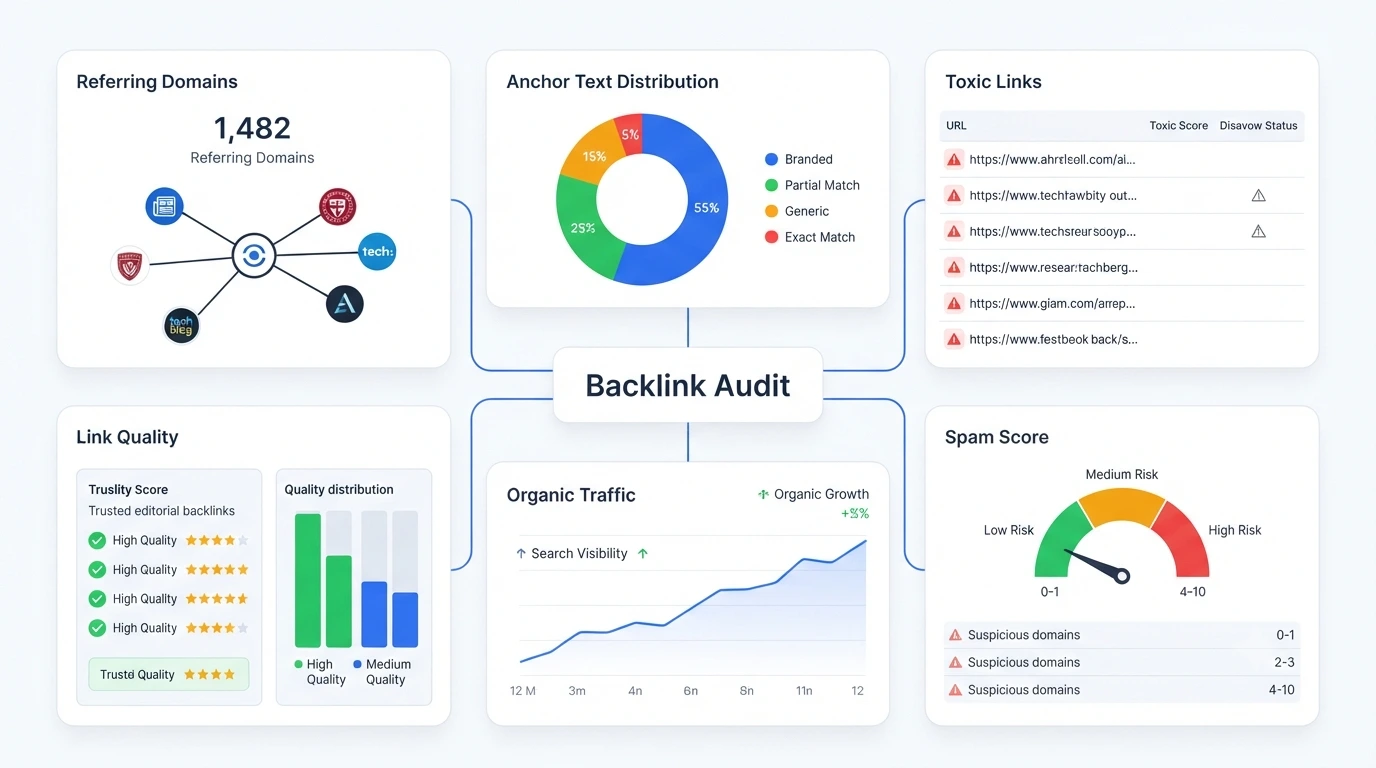
Pull your complete backlink profile using tools like Ahrefs, Semrush, Majestic, or Moz. Look for the following signals:
- A high proportion of links coming from very low-authority domains
- Domains with little or no organic traffic of their own
- Excessive use of the same anchor text across many referring domains
- Links from sites that are clearly link farms or content mills
- Sudden spikes in link acquisition that look unnatural in your timeline
Step 2: Categorize Every Link
Go through your list and categorize every link into three categories:
- Links that are good and you don’t have to do anything with
- Links that you are not sure about but that require manual checking
- Links that are bad and require either deletion or disavow
This is a step that requires quite some time, particularly in case of a huge profile, but it is absolutely necessary. Toxicity scores produced by automated tools such as Semrush can be used to expedite this stage; however, any tool is far from perfect and thus cannot be relied upon blindly.
Step 3: Reach Out for Removals
For those links that you want to delete or at least get rid of, try contacting the owner or webmaster of the website and ask him to do so. Keep records of all the attempts and contacts made during this step.
Step 4: Disavow What You Cannot Remove
For links that you failed to remove via contacts, create a disavow file and submit it through Google Search Console. The Disavow tool signals Google to ignore links in question when evaluating your website. However, keep in mind that you should not go into disavowing links blindly.
How to Get Google to Reconsider Your Penalty?
Once your audit and cleanup are complete, you can submit a reconsideration request through Google Search Console.
A strong request includes three things:
- An honest account of what happened and how the problematic links came to exist
- A detailed record of the steps you took to fix the issue, including outreach logs and your disavow file
- A clear commitment to maintaining link-building practices that align with Google’s guidelines going forward
Google reviews these manually. Response times vary, but most sites hear back within a few weeks. If the request is approved, the manual action is lifted, and rankings can begin recovering over the following weeks and months. Patience is important here. Continue building quality content and earning legitimate links while you wait.
How to Prevent an Unnatural Links Penalty?
The steps below make a meaningful difference in keeping your backlink profile clean from the start.
Vet Every Site Before Pursuing a Link
Look beyond domain authority numbers. Visit the actual website. Ask yourself whether it serves a real audience, whether the content is genuinely useful, and whether a link there would make sense to an actual reader. If the site exists primarily to sell placements, pass on it.
Keep Your Anchor Text Varied
A natural backlink profile contains a mix of branded anchors, naked URLs, partial match phrases, generic terms, and yes, some exact match anchors. When any one type dominates too heavily, the profile starts looking engineered.
Audit Your Backlinks Regularly
A quarterly review of your backlink profile lets you spot and address issues before they compound. Link profiles are not static. New links appear, sources degrade, and patterns can shift over time.
Disavow Obvious Spam Early
If you notice a sudden influx of spammy links from unrelated or clearly manipulative sources, address it promptly. Waiting to see if it becomes a problem is a less effective approach than catching it early.
How to Build Links More Naturally?
Here, patience pays off. Links that were built based on real value remain effective after algorithm changes, bring referral traffic, and accumulate authority in the long run.
Create Content That Earns Citations on Its Own
Unique research findings, proprietary data sets, thorough case studies, and original opinions make people link to your content automatically. If you create an original piece that others cannot find elsewhere, journalists use it for their purposes because it complements their content, not because you’ve asked them to do so.
Here are some of the types of content that are particularly effective when it comes to getting natural backlinks:
- Researches and surveys that include original data others would like to cite
- Thorough how-to guides that can be used as references in your area
- Opinion pieces that state your position clearly and provide supporting evidence
- Tools or calculators useful for the site visitors
- Comprehensive guideposts that are actually more thorough than any other guide on the market
Build Real Relationships in Your Industry
Connecting with bloggers, journalists, and influencers in your field leads to the development of links because of the connections developed. This will manifest itself in the form of an article being mentioned in their email newsletters or quotes being included in roundup posts or podcast summaries.
Pursue Guest Contributions Strategically
Contributing guest posts on relevant and high-authority sites that provide value to the audiences on such sites is a viable way forward. It is important to consider the relevance of the website, the content of your post, and the natural link placement.
Use Digital PR to Earn High-Authority Placements
Digital PR campaigns that involve the use of newsworthy information, stories, or insights may result in getting links from highly reputable sites that would have otherwise been out of reach using traditional link-building methods.
A strategically placed data story or expert opinion can produce many editorial links from one PR campaign alone.
Think About Topical Authority, Not Just Individual Links
Google increasingly rewards sites that demonstrate consistent, deep expertise in a defined subject area. When your site becomes a recognized resource in your niche, links follow from that reputation. Every piece of content you publish should reinforce your authority in your topic area, not dilute it.
Aim for Repeated Mentions, Not Just One-Off Links
A link from a trusted publisher is valuable. Multiple links from that same publisher over time, as your content continues to earn references, compounds that value significantly. Becoming a consistent source of quality information for the sites that influence your audience is one of the most powerful link building outcomes available.
Building a Resilient Foundation
Unnatural links are one of the more fixable challenges in SEO. The path forward is clear: run regular audits, address issues proactively, build relationships with sites that have real audiences, and put your energy into content that earns its place on other people’s pages.
The backlink profiles that hold up over time are the ones built on genuine value. When you approach link building that way, you are not just protecting your rankings from the next algorithm update; you are building something that consistently works in your favor.
Frequently Asked Questions
What is the difference between a natural link and an unnatural link?
A natural link is placed editorially by a website owner who found your content genuinely useful for their audience. No incentive was involved. An unnatural link exists because of an exchange, purchase, scheme, or automated process. The core difference comes down to intent and editorial independence.
Can unnatural links show up on my site without my involvement?
Yes, and it is more common than most people realize. Negative SEO campaigns, spam bots, and third parties can point manipulative links at your domain without your knowledge. Regular backlink audits help you catch these early and address them before they accumulate into a pattern that creates real risk.
Do all unnatural links result in a Google penalty?
Not necessarily. Google may choose to devalue certain links algorithmically rather than issue a formal manual action. Either way, those links stop providing value and carry an ongoing risk of triggering further scrutiny. A large enough concentration of manipulative signals can eventually prompt a manual review even if individual links seem minor.
How long does recovery from a penalty typically take?
Recovery timelines vary depending on the severity of the penalty, the size of your backlink profile, and how thoroughly the cleanup was done. Some sites see meaningful improvement within a few weeks of a manual action being lifted. Others take several months for rankings to stabilize fully. Continuing to build quality content and earn legitimate links during the recovery period helps accelerate the process.
Is the Google Disavow Tool still useful?
Yes. While Google has become more capable of ignoring low-quality links on its own, the Disavow Tool remains an important resource when dealing with a manual action or a targeted negative SEO attack. Use it carefully and deliberately. Focus on links you are genuinely confident are harmful rather than disavowing everything that looks unfamiliar.
What makes anchor text look unnatural to Google?
Anchor text looks unnatural when it appears coordinated. Specifically, when a high proportion of your backlinks all use the same keyword-rich phrase, it signals that someone engineered those placements rather than different publishers independently choosing to reference your content. A healthy anchor text mix is varied and reflects how different writers naturally describe what they are linking to.
Can I handle an unnatural links cleanup on my own?
Many site owners successfully manage this process independently using tools like Ahrefs, Semrush, and Google Search Console. If your profile is large, if you have received a formal manual action, or if you are seeing significant traffic loss, working with a reputable SEO professional can make the process faster and reduce the risk of making things worse.
What is the single most effective thing I can do to prevent unnatural links?
Vet every link source before you pursue it. Quality control at the acquisition stage prevents most problems before they start. If a website does not serve a real audience, lacks editorial standards, or exists primarily to sell link placements, the link is not worth pursuing regardless of what its domain metrics suggest.