
If you have spent any time doing SEO, you already know that backlinks matter enormously. But what many people overlook is that the words attached to those links carry just as much weight as the links themselves. Anchor text is one of those quiet ranking forces that, when handled thoughtfully, can make a meaningful difference in how well your pages perform on Google.
This guide covers everything you need to know about anchor text optimization, from the basics of what it is and how it works to a set of practical rules you can apply to any link-building campaign starting today.
What Are Anchor Texts?
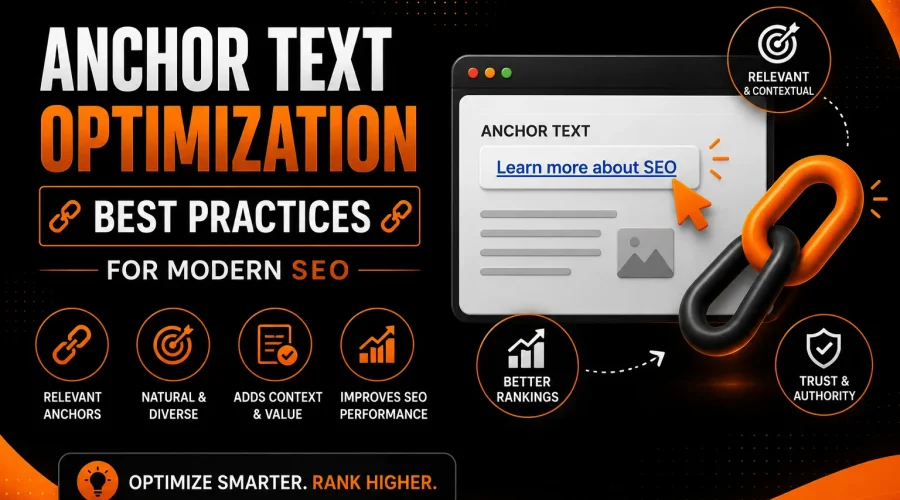
Anchor text is nothing but the hypertext link which leads to other pages from that particular text. You can easily find out the anchor text when you see any blue colored and underlined text on any article.
The anchor texts act as editorials to create links between various pages. In fact, anchor texts go beyond the scope of mere representation of some words. There will be contextual sentences around the anchor text. Thus, the anchor text would be of great use to both the readers and even the search engines to find out the relationship between the two pages.
Any good anchor text would have two objectives. It would serve the purpose of creating a natural link between two related pages, and it would help the user get to know about another resource through which he would be benefitted during his reading process.
Types of Anchor Text
There are several categories of anchor text that every SEO professional should be familiar with. Understanding each type helps you make intentional, strategic choices rather than guessing.
Branded Anchors
These use your brand name or website URL as the anchor. Examples include the company name, the full website address, or a variation of the brand name. Branded anchors are the cornerstone of a healthy link profile because they reflect how real people naturally reference a business they trust and recommend.
Natural or Generic Anchors
These are the accessory phrases that writers naturally use when linking out to another resource, things like “this in-depth guide,” “learn more here,” or “visit their website.” They do not contain keywords, but they signal organic, editorially motivated linking behavior.
Partial Match Anchors
Partial match anchors blend a target keyword with surrounding words to keep things feeling descriptive and natural. For example, rather than using a bare keyword as your anchor, you might wrap it into a phrase like “an actionable guide to link building strategies” or “the full breakdown of link building tactics from this agency. ” These are incredibly useful because they carry keyword relevance without looking forced.
Exact Match Anchors
Exact match anchors use a target keyword exactly as it appears in a search query, with no additional words around it. These are the most powerful in theory but also the riskiest to overuse. Google pays close attention to exact match anchor frequency, and an anchor profile with too many of them raises a flag that something unnatural is happening.
Google’s Stance on Anchor Text
Anchor text is a confirmed ranking factor; Google analyzes it to understand the topic of the destination page. To maximize effectiveness and minimize risk, keep these core principles in mind:
- Context is Key: Google prefers descriptive, longer anchor text over “bare” keywords. Phrases that provide context help search engines better understand the relationship between the linking and destination pages.
- The Penguin Lesson: Since the 2012 Penguin update, Google has aggressively penalized sites for manipulative, keyword-heavy anchor profiles. This remains a core part of their algorithm today.
- Prioritize Relevance: Links from irrelevant pages or contexts are a red flag. High-quality, sustainable SEO relies on a measured, diverse, and relevance-first approach.
Avoid aggressive keyword targeting, especially on commercial pages, and always favor natural, editorial-style phrasing.
Rule 1: Competitor Modeling
Use competitor analysis to identify successful patterns, but do not copy them blindly. Use tools like Ahrefs to examine the anchor profiles of top-ranking pages for your target keywords.
- The Process: Analyze the top five ranking pages, categorize their anchor types, and identify the distribution mix. You will likely find a blend of branded, partial match, generic, and URL anchors.
- The Caution: Domain authority is a major variable. Established sites with high trust can absorb aggressive anchor strategies that would penalize a newer website. Always evaluate whether a competitor’s authority justifies their strategy before mirroring it.
Rule 2: Keep It Natural
Every anchor must feel organic to the reader. If a link feels wedged in or oddly specific, it likely signals an SEO-first approach rather than a reader-first one.
- The Test: Read the paragraph as if you were an editor. If the link adds genuine value and clarity, keep it.
- The Mindset: Prioritize writing quality over keyword insertion. The best anchors emerge naturally from the surrounding content instead of being forced into it.
Rule 3: Variety Is a Strength
A healthy anchor profile mirrors the organic way people link to content, which is never uniform. Avoid using the same anchor text repeatedly.
- The Strategy: Aim for a diverse profile where no single phrase dominates. Because two independent writers rarely choose identical wording, replicating this variety makes your site appear more authentic to search engines.
- Editorial Observation: Spend time reading top industry publications specifically to study their linking habits. Notice how they wrap references in context and avoid bare keywords. Once you recognize these patterns, your own linking decisions will reflect natural editorial behavior.
Rule 4: Relevance Above All
Google evaluates the full context of a link, including the paragraph and the page topic. A link’s effectiveness depends heavily on the relationship between the source and the destination.
- Prioritize Context: A partial match anchor within a highly relevant article will always outperform an exact match anchor on an unrelated page.
- Contextual Signaling: If you use a generic anchor, you can still signal relevance by ensuring your target keyword appears naturally in the surrounding text. This provides Google with the necessary context even without keyword-heavy anchors.
Rule 5: Consider the Destination Page
Your anchor text strategy should align with the nature of the page you are linking to. Different page types naturally attract different linking behaviors, and mirroring these patterns is essential for an authentic profile.
- Homepage and Service Pages: These should primarily receive branded anchors. Real users reference businesses by name, not by the specific keywords you want to rank for.
- Informational Content: Blog posts and guides are more naturally linked using descriptive or keyword-adjacent phrases. Since these pages act as resources, writers tend to use anchors that reflect the specific topic being covered.
Avoid pushing keyword-rich anchors toward commercial or service pages, as this mismatch is easily detected by Google. The safest and most effective approach is to let the page type dictate your anchor strategy, reserving specific keyword targeting for informational content where it fits naturally.
Anchor Text Ratios Worth Following
Having a general framework for anchor distribution helps you build toward a profile that looks natural without leaving things to chance. The following ratios are a solid starting point for most websites, though your competitor research should always be the primary reference.
For Homepages and Service Pages
- 80% branded anchors
- 10% partial match anchors
- 5% generic anchors such as “this guide” or “learn more”
- 5% naked URLs
For Informational and Blog Content
- 30% branded anchors
- 20% title tag or meta title variations
- 20% partial match anchors
- 10% anchors that combine brand name with a keyword
- 10% generic anchors
- 5% naked URLs
- 5% exact match anchors
These percentages are guidelines rather than strict rules. The goal is a profile that reflects authentic editorial diversity, so treat these ratios as targets rather than ceilings.
When to Use Exact Match Anchors
Exact match anchors are not inherently problematic. The issue arises when they are used excessively or in contexts where they feel out of place. There are situations where exact match anchors appear naturally and are entirely appropriate.
Definition pages and informational content about specific concepts or events tend to attract exact match anchors organically. A page explaining what a CRM is will naturally be linked with the anchor “CRM” by writers who reference it as a definition. A historical event page will naturally attract the name of that event as its anchor. In these cases, the anchor is simply the most accurate way to describe what the destination page is about.
Pages on extremely authoritative domains can also carry a higher percentage of exact match anchors without adverse effects, because Google’s trust in the domain provides the context it needs to evaluate those links charitably. For everyone else, exact match anchors should be used sparingly and only when the context makes them feel genuinely natural.
When Exact Match Anchors Are a Risk
Using an exact match anchor to link to a commercial or service page from an unrelated article is one of the clearest signals of manipulative link building. It is the scenario that Penguin was designed to detect. If the anchor is a bare keyword query, the destination is a sales or service page, and the surrounding content has no clear relevance, that link is working against you more than for you.
Before placing any exact match anchor, ask whether a real writer would have naturally chosen those words to describe that link in that context. If the honest answer is no, a branded or partial match alternative is almost always the better path.
What Pages Should You Be Linking To?
Not all pages on your website benefit equally from external links, and your link building energy should reflect that reality.
Informational content is the most natural recipient of backlinks. When someone writes an article and references a useful resource, they typically link to a page that explains or explores a topic in depth. Building links to blog posts, guides, and educational content aligns with real linking behavior and carries the least risk.
Your homepage is also a worthy target for links, particularly branded ones. A strong volume of branded links to your homepage builds domain-level trust that benefits all of your pages indirectly. Think of it as investing in the foundation that your commercial pages stand on.
Commercial and service pages should receive links more selectively. When you do build links to these pages, focus on branded anchors or contextually relevant partial match phrases, and make sure the source content genuinely supports the link as an editorial recommendation rather than a placement.
Geo-Location Anchors
Anchor text optimization becomes a bit more delicate when geographical location enters the picture. Local SEO campaigns often tempt link builders into using hyper-specific location keywords in anchors, but this is an area where restraint pays off.
When linking to a page targeting a specific city or region, ask whether the location is genuinely relevant to the audience of the linking page. If the linking site serves a national or international audience, stuffing a local modifier into the anchor serves neither the reader nor the algorithm well.
Geo-specific anchors can work well when the context supports them organically. A local directory, a regional publication, or a community-focused website linking to a local business with a location-aware anchor makes complete sense. But chasing geo anchors on unrelated sites because competitors appear to be doing it is a pattern worth approaching carefully.
Always verify that competitors who use aggressive geo-anchor strategies are benefiting from it because of their site’s long-standing authority rather than because the tactic itself is inherently safe.
What Good Anchor Text Actually Looks Like
To master anchor text, observe how high-performing sites implement links. Effective anchors should feel invisible, enhancing the sentence rather than disrupting it. When a link feels like a natural next step for the reader, it is usually performing well for SEO.
- Branded Anchors: Use these for commercial pages within listicles or resource articles. A sentence such as “If you are looking for a reliable option, Brand X has strong reviews across multiple categories” serves as a natural, editorial recommendation that Google trusts.
- Partial Match Anchors: These are most effective when the anchor phrase serves as a descriptive title for the destination page. Using “a complete guide to sustainable packaging for e-commerce” as an anchor reads like a helpful description rather than a forced keyword injection.
- Generic Anchors: These work best when the surrounding paragraph provides the necessary context. Phrases like “we found a resource worth bookmarking” allow the text around the link to provide the keyword signals while keeping the anchor itself clean.
Ultimately, study the top writers in your industry. Their linking instincts have been refined by years of editorial feedback, and mimicking that natural, reader-focused behavior is far more effective than following a rigid framework.
Final Thoughts
Anchor text optimization is one of those areas of SEO where small, thoughtful decisions compound into meaningful outcomes over time. Getting it right does not require complex tactics. It requires consistency, variety, relevance, and a genuine respect for how editorial linking behavior actually works.
The websites that sustain strong rankings across algorithm updates are almost always the ones that have treated their link profiles as something to build with care rather than to game. By following the principles in this guide, modeling competitor strategies with appropriate judgment, and always asking whether each anchor text would pass the editorial eye test, you give your pages the best possible foundation to perform.
Start with what you can control, stay patient with the results, and let the quality of your approach do the work for you over time.
Frequently Asked Questions
How many exact-match anchor texts is too many?
There is no universal number that applies to every website, because it depends heavily on your domain authority, page type, and competitive landscape. As a general principle, keeping exact match anchors below five percent of your total anchor profile for commercial pages is a sensible target for most sites. Informational pages can tolerate slightly more, particularly when the anchor is the most natural way to describe what the page covers.
Does anchor text still matter for SEO in the current landscape?
Absolutely. Google has confirmed that anchor text is a genuine ranking signal, and this has not changed with algorithm updates. What has changed is how Google evaluates anchor text, placing much more weight on context, relevance, and natural distribution than on keyword density alone.
Should I use the same anchor text for internal and external links?
Internal links follow slightly different rules than external links because you have full control over them and they do not carry the same manipulation risk. For internal links, consistency in how you reference key pages can actually help reinforce topical signals. For external links, variety and naturalness take priority.
How do I build a diverse anchor text profile without losing keyword relevance?
The best approach is to use partial match anchors generously, varying the surrounding words while keeping your core keyword concept present. You can also ensure your target keyword appears in the paragraph surrounding a branded or generic anchor, which gives Google contextual signals without requiring the keyword to appear in the anchor itself.
Is it worth pursuing anchor text backlinks to a brand new website?
Yes, but with particular care. New websites benefit most from branded anchor links that build foundational trust with Google. Prioritize keyword-rich anchors to commercial pages only after establishing some domain history, and focus on earning links to informational content where descriptive, natural anchor text fits more easily.
Can a poor anchor text profile be recovered if it has already been damaged?
Recovery is possible, though it takes time and consistent effort. The process typically involves auditing your existing backlink profile, identifying over-optimized or irrelevant anchors, and working to build a more diverse set of new links that balances the profile over time. Disavowing genuinely toxic links may also be part of the strategy depending on the severity of the situation.
How does surrounding content affect anchor text performance?
Google looks beyond the anchor itself and evaluates the full paragraph and page for contextual signals. A generic anchor placed within a highly relevant, well-written paragraph about your topic will often perform better than an exact match anchor dropped into an unrelated article. Surrounding content is a meaningful quality signal.
What is the best tool for analyzing anchor text distribution?
Ahrefs is widely considered the most comprehensive tool for this purpose, offering detailed anchor text breakdowns for any URL. Semrush and Moz also provide anchor analysis features. For the most actionable insights, pull data from at least two tools and cross-reference the results before finalizing your strategy.