
You’ve invested countless hours into creating solid content, fine-tuning your on-page elements, and chasing the right keywords. Still, your pages sit buried while competitors with what look like ordinary sites claim the top spots in Google. Opening up your go-to SEO platform, you pull up the numbers: one rival shows a solid domain authority score, while another flexes an eye-catching domain rating.
The big question hits you: Which of these should actually shape your link-building choices, content roadmap, and day-to-day SEO moves? And why do the same domains often paint such different pictures depending on the tool?
This kind of uncertainty trips up marketers and business owners all the time in crowded search spaces. DA and DR have turned into quick shorthand for judging site strength, but leaning on them without context can burn your budget on weak links or cause you to overlook domains that truly deliver.
In this detailed guide, we’ll unpack exactly what each score represents, where they diverge, how they fit into today’s SEO reality, and how to blend them with other important signals for smarter, more effective outcomes.
What Is Domain Authority (DA)?
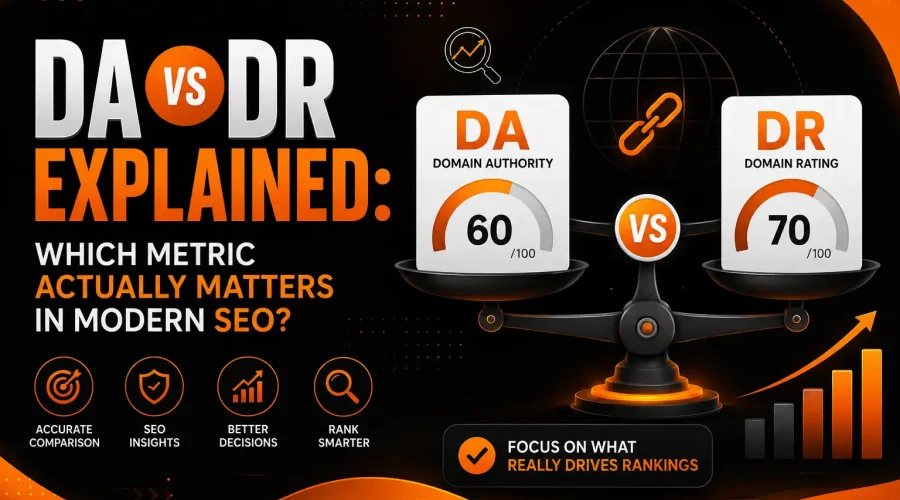
Domain Authority stands as Moz’s well-known metric designed to forecast how likely a website is to appear prominently in search engine results. It runs on that familiar 0 to 100 scale, where climbing higher suggests stronger potential to compete for visibility.
Rather than simply tallying links, Moz’s system draws from a wider pool of elements. Backlinks still play a major role, but the score also weighs things like spam signals, patterns in site traffic, how long the domain has existed, and various other clues that help approximate real ranking power.
Machine learning models trained on actual search result data power this prediction, giving it a practical edge when sizing up competition.
This broader lens makes DA especially handy for competitive reviews. You can scan the typical DA levels among top-ranking pages in your field and set grounded goals for your own progress.
For example, in tough sectors like finance or healthcare, leading results often come from domains sitting in the 60 to 90-plus range. In narrower or less contested areas, though, you might achieve strong presence with scores between 30 and 50.
Core traits that define DA:
- Created by Moz through advanced machine learning.
- Focused on predicting future ranking ability instead of pure link volume.
- Refreshed on a less frequent cycle, commonly once a month.
- Shaped by signals beyond links alone, such as overall site quality and spam-related flags.
What Is Domain Rating (DR)?
Domain Rating comes from Ahrefs and zeros in tightly on the quality and power of a site’s incoming backlink structure. It also uses the 0–100 logarithmic scale, but its foundation rests almost completely on the volume and caliber of external links directed at the domain.
Ahrefs examines the count of unique referring domains, the DR values of those sources, and how spread out their own linking power becomes across other sites. This produces a clear picture of how authority might transfer.
Links marked as nofollow typically get left out, and the emphasis lands more on variety in sources than on massive numbers of individual connections.
DR serves as a practical compass during link acquisition drives. Domains with elevated scores generally transfer more meaningful strength, and research often shows tight connections between higher DR and improved visibility, though remember that correlation alone does not prove direct cause.
Core traits that define DR:
- Built by Ahrefs with heavy emphasis on backlink characteristics.
- Logarithmic design means upward movement grows tougher at higher levels; jumping from 70 to 80 demands far more work than moving from 20 to 30.
- Refreshes more regularly, often capturing new links within days.
- Stays narrowly centered on links, offering clarity but also greater vulnerability to artificial boosting through questionable methods.
DA vs DR: Key Differences at a Glance
Even though both scores try to capture the idea of “authority,” their distinct methods create noticeable practical differences that influence real-world application.
| Aspect | Domain Authority (DA) | Domain Rating (DR) |
| Provider | Moz | Ahrefs |
| Primary Focus | Predicted ranking strength across multiple factors | Depth and power of the backlink profile |
| Calculation Factors | Links, spam signals, traffic patterns, and more | Mainly unique referring domains and their “link juice” |
| Best For | Benchmarking against rivals and market gaps | Screening and prioritizing link targets |
| Update Frequency | Usually monthly | Often within days |
| Manipulation Risk | Somewhat lower due to wider data inputs | Higher, as link schemes can inflate the number |
| Scale & Behavior | Logarithmic and highly comparative | Logarithmic and strictly link-centric |
It is completely normal for one domain to score differently across the two systems. A site rich in focused, industry-specific connections might register stronger on DR, while another with cleaner signals across the board performs better on DA. Checking both gives you a fuller, more reliable viewpoint.
Why These Metrics Matter (But Aren’t Everything)
Keep in mind that neither DA nor DR counts as an official ranking ingredient inside Google’s system. The company has stated clearly that it does not rely on these external scores. That said, the real elements underneath them, particularly strong, relevant backlinks, line up closely with what actually influences search placement.
Large-scale analyses, including Backlinko’s deep dives into millions of results, repeatedly reveal solid ties between elevated DA or DR levels and stronger positions.
Domains carrying robust link histories and authority cues tend to fare better, especially where competition runs hot. Still, relevance, depth of content, smooth user journeys, and solid technical foundations often decide the final outcome.
Practical cases bring this home clearly. A fresh site sitting at a modest DR of 5 to 15 can sometimes claim the number one spot for well-chosen terms by landing just a few highly targeted, trustworthy links paired with standout material.
On the flip side, domains pumped up through questionable networks may show impressive numbers yet deliver little ranking lift or, worse, attract penalties once manipulation surfaces.
Think of these scores as helpful filters rather than final judgments. They speed up decision-making and help focus energy, but they work best when paired with careful review of actual visitor data, topical fit, and content performance.
How to Use DA and DR Effectively in Link Building and SEO Strategy?
Experienced practitioners treat these figures as helpful entry points rather than complete roadmaps. Here is how to weave them into your workflow thoughtfully:
- Prospecting and Filtering Opportunities Start with DR to scan potential link sources quickly; it highlights domains with genuine backlink substance. After clearing a sensible threshold (perhaps 40 or higher, adjusted for your niche), cross-check with DA and then dig deeper into relevance, real traffic levels, and content strength.
- Competitor Analysis DA proves valuable here. Map out the spread of DA values among ranking pages in your target searches to gauge the bar you need to clear. Layer in DR to understand whether that authority comes mostly from links or from other healthy signals.
- Benchmarking Progress Monitor shifts in your own DA and DR as rough guides of link-building momentum. Clear upward movements can confirm that campaigns are landing well, while plateaus might signal a need to refresh your approach to quality or diversity.
- Avoiding Common Pitfalls
- Watch out for domains showing high scores yet featuring weak writing, off-topic focus, or suspicious link patterns.
- Always go past the numbers: review site design, traffic trends over time, anchor text balance, and genuine editorial value.
- Stay alert to manipulation risks: aged, expired domains; private networks; and low-effort guest placements can inflate figures without bringing lasting benefits.
Complementary Metrics and Holistic Evaluation
Depending on only DA or DR narrows your perspective too much. Bring in these additional layers for well-rounded choices:
- Organic Traffic Trends: Real visitor numbers reveal whether Google and users actually value the site.
- Topical Alignment: Connections from closely related niches almost always outperform broad but generic high-score domains.
- Keyword Performance and Traffic Value: These show if the site earns visibility on terms that truly matter.
- Anchor Text Balance and Link Growth Patterns: Help identify unnatural spikes or distributions.
- Content Depth and Engagement Signals: Strong interaction often points to more sustainable long-term strength.
Platforms like Ahrefs’ Site Explorer and Moz’s Link Explorer unlock richer details when used together. Quick free checkers work for fast glances, but dedicated subscriptions open up the full picture needed for serious campaigns.
Strategies to Improve Your DA and DR
Raising these scores overlaps heavily with timeless, effective SEO habits:
- Pursue Varied, Valuable Backlinks: Prioritize natural growth through exceptional content, targeted outreach, and thoughtful digital public relations.
- Develop Truly Link-Worthy Resources: Publish comprehensive studies, unique data sets, interactive tools, and insightful guides that naturally draw attention.
- Strengthen On-Page and Technical Foundations: Ensure fast loading, mobile readiness, and logical structure so link value gets fully realized.
- Establish Clear Topical Expertise: Build thorough content clusters that position your site as a trusted voice in the space.
- Keep Your Profile Clean: Regularly review and disavow harmful links while staying vigilant against spam risks.
Growth follows a logarithmic path; steady, patient effort compounds powerfully. Moving from a DR around 30 up toward 50 through focused work frequently unlocks noticeable ranking gains over time.
Which Metric Matters More in Modern SEO?
No single metric claims victory between DA and DR. DR delivers a sharper, link-specific view that shines during prospecting and authority flow analysis. DA offers a wider, forward-looking perspective ideal for positioning against competitors and tracking broader progress.
The winning formula combines both while keeping primary attention on authentic factors: strong relevance, genuine traffic potential, content that truly serves readers, and ethical, sustainable expansion.
In the 2026 SEO environment, where Google places growing weight on E-E-A-T principles and genuine user-focused signals, tools like DA and DR remain convenient aids, but they support strategy rather than replace it.
Concentrate on building real authority by delivering consistent value and building connections the right way. The scores will rise naturally, and your actual rankings and traffic will follow even more meaningfully. Keep auditing your methods, validate assumptions with fresh data, and stay flexible as search habits shift.
This thoughtful balance is what separates campaigns that thrive from those merely chasing impressive-looking numbers.
Ready to build stronger, more meaningful authority for your domain? Begin by reviewing your current backlink situation and competitor landscape through both lenses, then layer on the qualitative elements that create enduring success. With clarity on what each metric truly shows, the route to better search performance becomes far more straightforward.
Frequently Asked Questions
Is it good for SEO if your site has a higher domain rating (DR)?
Not always. Yes, DR is usually an indicator of more powerful backlinking, but sometimes it may be increased thanks to spam links. Always make sure that the site has organic traffic and relevancy, so it would be clear whether high DR is beneficial.
Why is my DA score different from my DR score?
It depends on the source of information and how DA and DR are calculated. Moz DA uses various data sources and weighs site quality, organic traffic, and other aspects, whereas Ahrefs DR is focused only on the number of backlinks and their “quality.”
Does Google use DA/DR for ranking my pages?
No, Google doesn’t use any of these metrics for rankings. These are external rankings provided by search engine optimization tools, so you can evaluate the authority of the site based on these indicators.
What are the best ways to increase DA and DR?
The best way is to work on building up high-quality backlinks from reputable websites within your industry by creating good content and maintaining a healthy technical foundation.
Is it beneficial to buy links with high DR?
It is not. Buying backlinks, especially those that do not have any relevance to your website or “link farms,” violates Google Webmaster Guidelines and may get you penalized. Instead of wasting money on paid links, use the budget for content marketing and PR.
How frequently do I need to monitor those two metrics?
Once a month would be enough for benchmarking purposes. Monitoring them more than that is simply a waste of time because building up authority is something that takes time, and worrying about the metrics daily is useless.
Can I only use DA or DR to determine link prospects?
Yes and no. DA/DR can be used for the first pass, but never rely solely on them and manually check the sites’ relevance to your business and their value to your visitors.