

It takes a lot of effort to go up the search ranks. It takes time to develop a backlink profile, technological polish, and quality content. Occasionally, however, a rival determines that it is quicker to undermine you than to elevate themselves. In a nutshell, that is negative SEO.
The good news is that these attacks rarely cause as much harm as people think, and once you know what you’re dealing with, practically every situation is recoverable.
We’ll go over what negative SEO actually means, the most common strategies used by attackers, how to see warning indicators early, and specific actions to make things right below.
What Negative SEO Actually Means?
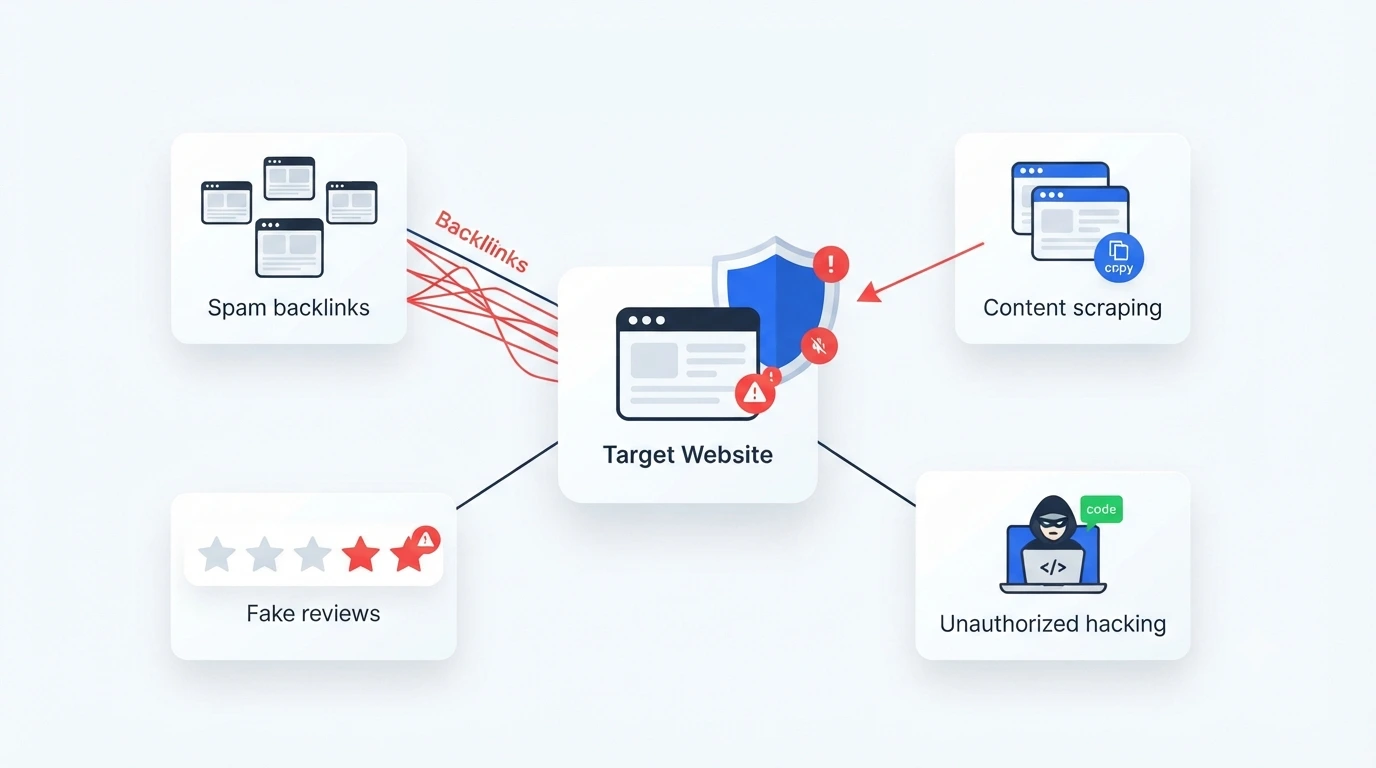
Negative SEO describes a set of tactics designed to hurt a competitor’s search performance instead of improving one’s own. The end goal usually falls into one of two buckets:
- Make the target site appear to be breaking search engine rules, hoping the algorithm steps in and suppresses it.
- Damage the brand’s image enough that real people stop trusting or clicking on it.
These tactics are unethical by any reasonable standard, and depending on what’s involved, some cross into legal trouble too. They’re also nowhere near as reliable as attackers hope. Google in particular has spent years refining how it spots manipulation, and a lot of these schemes get filtered out long before they cause any real harm.
Still, understanding how the playbook works is worth your time. Half the protective measures below are simply good SEO habits you should already have in place.
Who’s Behind These Attacks, and Why?
Negative SEO shows up most in crowded, competitive industries where the stakes feel high. Smaller or newer sites tend to be the easiest targets, mainly because they haven’t built up enough authority or backlink volume to absorb the impact when something goes wrong.
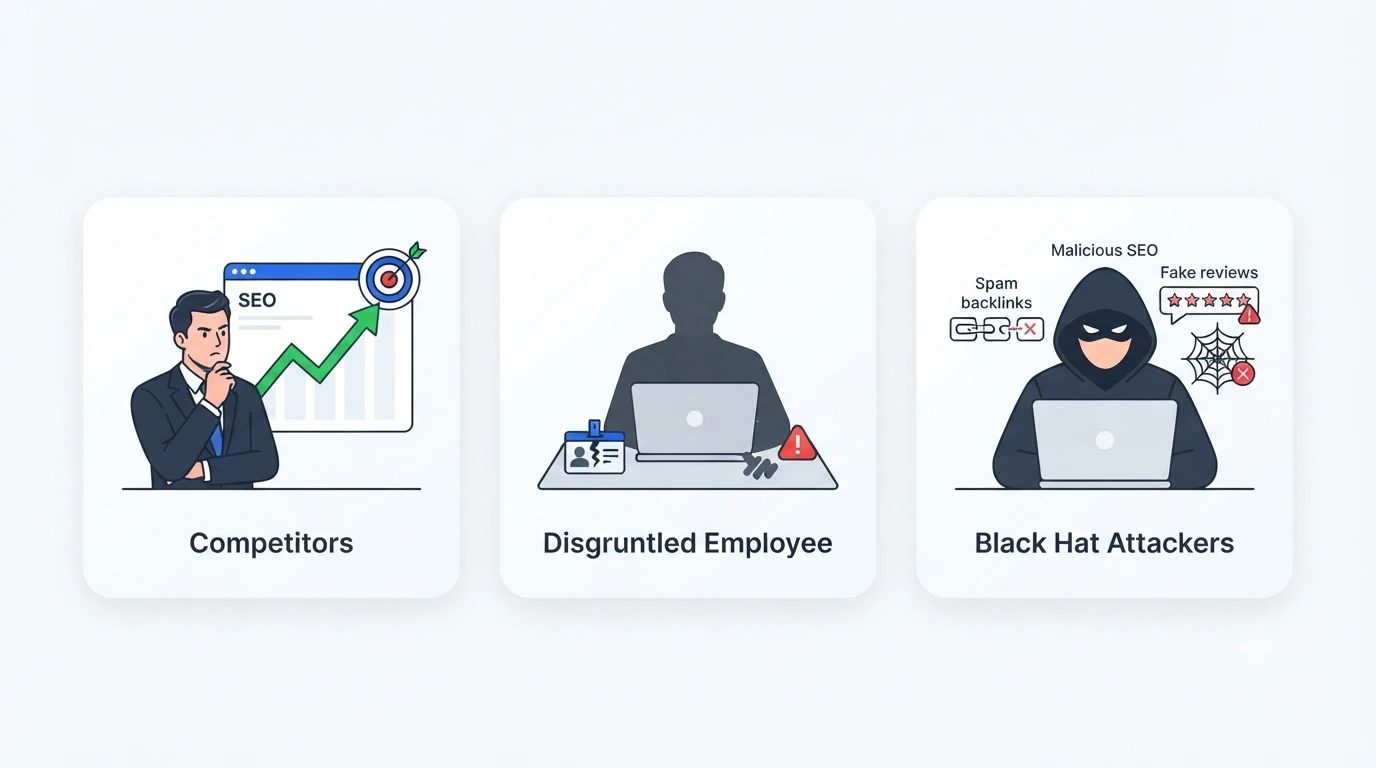
A few patterns tend to repeat:
- A rival business looking for an easy shortcut instead of outranking you the proper way.
- A disgruntled current or former employee acting out of spite.
- Plain bad luck. Sometimes site owners or inexperienced freelancers unknowingly use black hat link building or other spammy SEO tactics. The resulting backlink profile can look almost identical to a negative SEO attack, even though no competitor was actually involved.
The Main Types of Negative SEO Attacks
Most incidents fall into a handful of recognizable categories. Here’s a breakdown of each.
Spammy or Manipulative Link Building
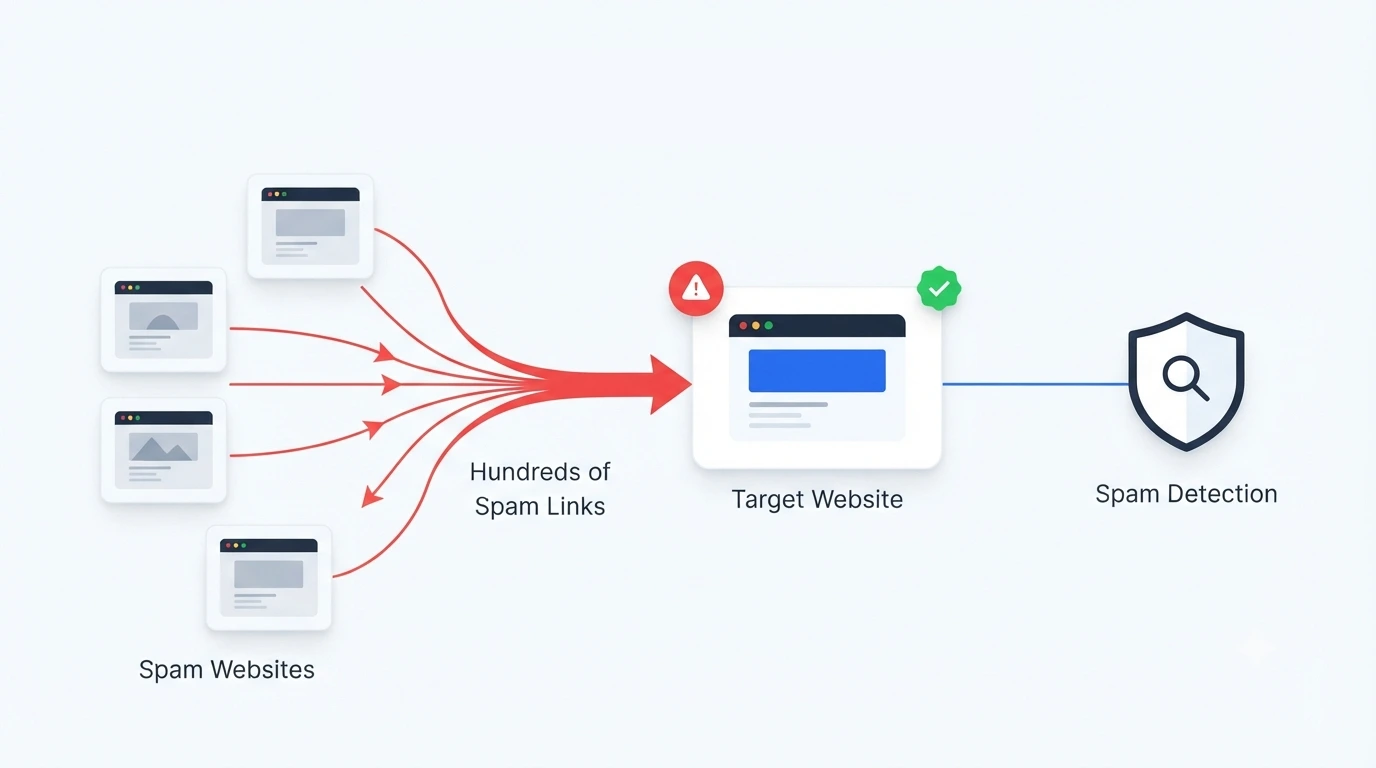
This is the tactic most people picture first. An attacker builds a large volume of low-quality backlinks, often from link farms or private blog networks, and points them straight at the target’s domain. The hope is that Google’s spam detection flags the pattern and penalizes the site for manipulative link building.
Two common variations show up here:
- Exact-match anchor spam. Hundreds of links using the same keyword-stuffed anchor text, designed to look unnatural and trigger a manual review.
- Irrelevant anchor spam. Links built using anchors tied to unrelated or unsavory topics, casinos, adult content, or payday loans, intended to drag the site’s reputation and topical relevance down by association.
Link Removal Sabotage
Rather than adding bad links, some attackers go after the good ones. They’ll contact webmasters who already link to a target site, pretend to be acting on the target’s behalf, and ask for the link to be pulled or swapped for something else.
Content Scraping
Scraping involves lifting a site’s content word for word and republishing it elsewhere. If the copy gets indexed before Google credits the original source, the duplicate occasionally outranks the real thing, quietly siphoning off traffic that should have gone to the original page.
False Copyright or DMCA Complaints
Another tactic is making false copyright complaints and claiming that a website is guilty of copyright violation on material that is actually owned by the accuser. Once the claim is proven true, the site will be removed from search engine results even if it is not guilty of anything.
Reputation Attacks and Review Bombing
This bucket covers a wide range of tactics:
- Defamatory blog posts or smear campaigns spread across forums and social media.
- Fake profiles created to impersonate a brand or its leadership.
- Coordinated waves of fake one-star reviews on Google Business Profile or similar platforms.
Review scores feed directly into local search rankings, so a sudden flood of fake negative reviews can hurt visibility and customer trust at the same time.
Click Fraud and Bot Traffic
Some attackers rely on bots to click into a target’s search results and immediately bounce away. The theory is that a spike in bounce rate signals to Google that searchers aren’t finding the page useful, which can erode rankings gradually over time.
Hacking and Site Tampering
This is the most serious category, since it requires actually breaking into a website. Once inside, an attacker might:
- Delete or deface existing content
- Redirect URLs toward spam or malicious destinations
- Edit the robots.txt file to block crawlers from important pages
- Strip out title tags, headers, or meta descriptions
- Inject malicious code that puts site visitors at risk
Unauthorized Hotlinking
Hotlinking happens when another website loads your images or media files directly from your server rather than hosting their own copies. At scale, this eats into your bandwidth, slows your site down, and can ultimately drag your page speed and rankings with it.
Signs You Might Be Under Attack
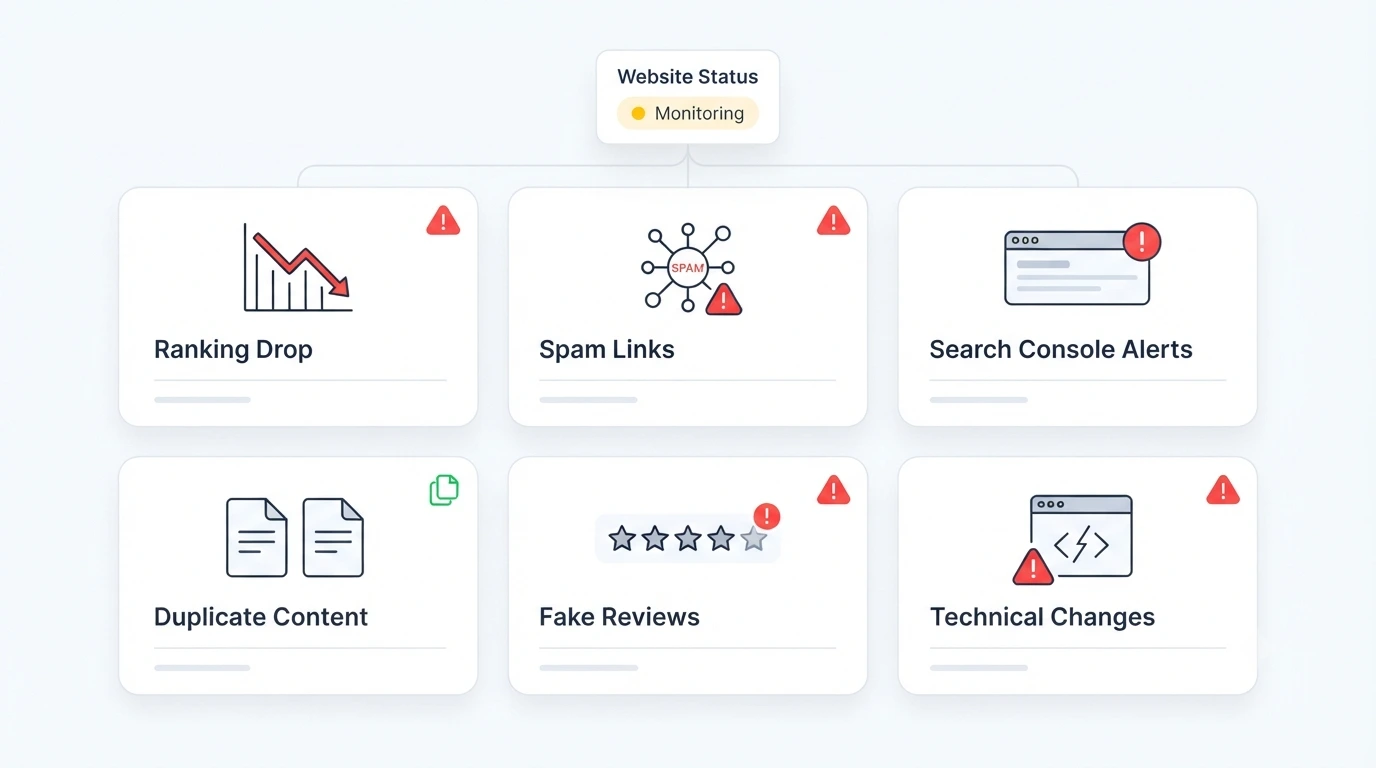
Most negative SEO leaves a trail somewhere. The key is checking the right places consistently, so problems get caught early rather than months later.
- Unexplained ranking or traffic drops. Worth investigating, though most dips actually trace back to algorithm updates or on-site issues rather than an outside attack.
- Sudden spikes in low-quality backlinks. Especially from unrelated domains or with unnatural, repetitive anchor text.
- Alerts inside Google Search Console. These often flag manual actions, security warnings, or indexing problems before you’d ever notice them another way.
- Unexpected changes to technical files. Watch your robots.txt file, canonical tags, redirects, and meta tags for anything you didn’t authorize.
- Duplicate content appearing elsewhere online. A plagiarism checker can flag this quickly.
- An uptick in negative brand mentions or reviews. Particularly if they appear in a short window and follow a similar script.
Recovering From a Negative SEO Attack
Once you know the kind of attack you are dealing with, you should proceed in this way to address each of them.
Spammy backlinks. Contact the webmasters of the websites where the links are from and ask for their removal. If there are some links that cannot be removed, make a disavow file and send it via Google Search Console. Be careful, however, as disavowing many backlinks at once may sometimes be more harmful than beneficial.
Removed legitimate backlinks. Contact the webmasters who took down your link and ask them if they would reconsider their decision if their link removal was prompted by someone posing as your company.
Content scraping. Directly contact the website hosting the stolen content and ask to remove it. If it does not help, a DMCA notice sent to Google will take the page from the search engine results.
False copyright claims against your business. Submit a counter notice to the platform in question and keep evidence proving that the content is yours.
Fake reviews or review bombing. Report the fake reviews to the platform where they were posted and respond to them in a professional way.
Hacking attacks. You should change credentials right away, enable two-factor authentication, recover from a fresh backup, and fix any hacked content, redirections, and tags. Then you have to do a thorough technical audit just to make sure that everything really got fixed.
Hotlinking. You can either use server-side hotlink protection or install a security plugin that will deny all unauthorized access to your media files.
In this entire procedure, don’t forget to make some notes. It might be useful in case you need to escalate your complaint to the search engines or even resort to law enforcement.
Preventing Future Attacks
Prevention is significantly more stress-free than the process of recovering from an attack, and almost all of the following tips are worth sticking with regardless of whether or not someone is trying to do you harm.
- Set up regular website audits to detect any technical problems or unwanted changes early.
- Always update your CMS, plugins, and themes, as outdated code continues to be one of the simplest ways for attackers to breach your defenses.
- Use strong passwords and turn on two-factor authentication where possible.
- Enable alerts through Google Search Console to receive instant notification when something goes wrong.
- Develop strong SEO foundations. Having high-quality content, good backlinks, and a good technical foundation makes a website much harder to topple.
Final Thoughts
Negative SEO attacks may be quite frightening from the very moment when their presence is noted, yet the truth is that in reality, such operations do not have the desired effect on search engines. They become increasingly good at recognizing manipulative behavior, and a solid website just shrugs off the blow like nothing happened.
The best approach to protection is to stay disciplined by monitoring your rankings, analyzing the quality of your backlinks, making sure your website is safe, and addressing problems in a timely manner. Investing time in your SEO campaign is always more beneficial than panicking over possible actions of your competitor.
Frequently Asked Questions
Is negative SEO illegal?
This depends on the strategy used and your geographical location. For example, hacking and making false copyright claims are punishable by law. However, some strategies remain questionable even if not illegal as per search engines.
Can negative SEO negatively affect my rankings?
Yes, though search engines now have become very smart at detecting such manipulations and ignoring them. Those websites that already have solid SEO structures can resist negative SEO strategies effectively.
How do I know if a fall in the rankings was due to negative SEO and not other factors?
Ranking declines usually happen as a result of algorithm changes, technical problems, or content gaps; rarely are they the consequence of any attacks. Perform a technical audit and rule out these reasons before suspecting negative SEO.
Does each suspicious backlink have to be disavowed?
No, Google algorithms are generally able to ignore spammy links by themselves. You should use the disavow tool when there is a manual penalty or a massive link campaign involved.
How long will it take to recover?
Depends on the kind of attack and how quick you act. Technical solutions such as recovery of hacked content may take just a few days. Removal of backlinks and reputation repair will likely take a few months.
Can I sue the person behind these attacks?
Yes, in some cases, especially those involving hacking, defamation, and fraudulent claims of copyright infringement. A lawyer will guide you through the possibilities regarding your particular case.
Am I going to get penalized by Google for these spammy links, which I have never created?
No, most likely. As stated multiple times by Google, the company understands very well what kind of links were not created by site owners and usually ignores them.
What is the best long-term solution to avoid being attacked?
Monitoring of the website combined with good technical and content practices. A properly maintained authoritative site is much harder to damage, and detecting any problems at an early stage prevents the attacks from developing further.