
For a long time, link building had a formula. You found sites, you placed links, you watched rankings move. It was mechanical, predictable, and honestly pretty easy to game if you had the budget for it.
Then Google started getting serious. Between 2022 and 2025, a series of spam updates rewired how Google thinks about backlinks entirely. Guest post networks got devalued. Link marketplaces became largely pointless.
Sites that had been riding PBN juice for years woke up one morning to traffic graphs that looked like a cliff. And the SEO industry had to ask a question it had been avoiding for years: what does link building actually look like when you can’t fake it anymore?
This guide answers that question clearly. What changed, why it changed, what got hit, and what the path forward actually looks like for people who want to build links that still matter in 2026.
What the Google Link Spam Update Actually Did
At its core, the Link Spam Update was not about penalizing bad links one by one. It was about Google getting smarter at recognizing the intent behind them.
The primary goal was neutralization, not punishment. Spammy, paid, or manipulative links do not always result in a manual action. More often, Google simply stops counting them. They exist in your profile but contribute nothing to your rankings.
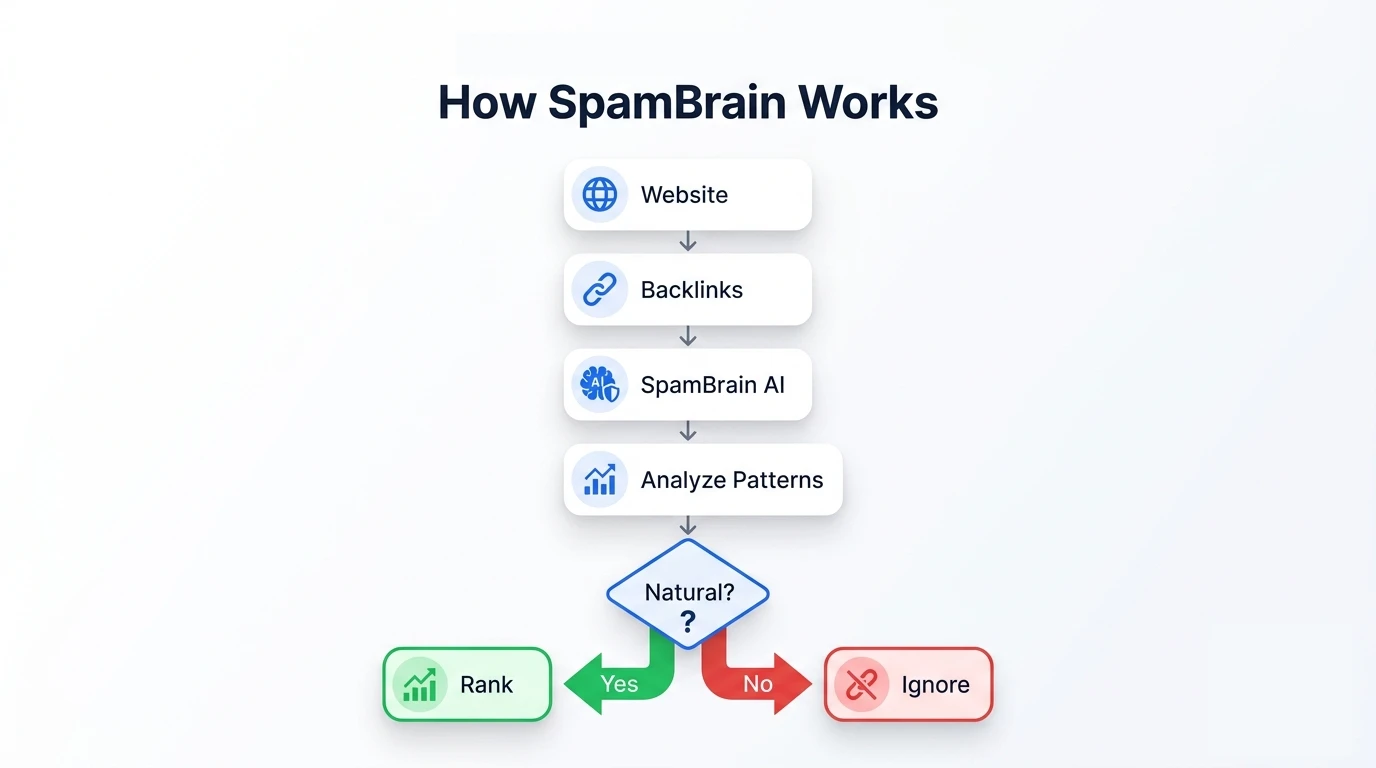
The system doing most of this work is SpamBrain, Google’s AI-powered spam detection engine. What makes it different from older approaches is that it evaluates links at the network level rather than in isolation.
It looks at patterns across linking domains, topic clusters, anchor text distribution, and the historical behavior of every site involved. Hiding a manipulative link inside an otherwise clean profile is no longer a reliable strategy.
The hardest truth to accept is this: once Google devalues your links algorithmically, cleaning them up does not restore what you lost. The ranking benefit those links provided is gone. The only winning position is to never depend on links that would not survive scrutiny in the first place.
What Got Hit Hardest
The updates didn’t affect all link-building approaches equally. Some tactics got quietly devalued. Others brought real penalties. Understanding the difference matters.
Guest Post Networks and Link Marketplaces
Guest posting on sites that only exist to buy and sell links is no longer viable. These links are mostly rendered worthless. The Helpful Content Update wiped out traffic from affiliate review sites, sites writing scaled content using only AI, and most sites that people relied on for guest posts typically found on link marketplaces. Only 6% of guest post sites analyzed were still considered high quality afterward.
The logic is straightforward. A site that publishes 40 guest posts a month from unrelated industries, all with commercial anchor text, all linking out to paying clients, is not acting like a real publication.
SpamBrain is specifically trained to detect that pattern. The links don’t get you penalized in most cases. They simply stop counting.
Exact Match Anchor Text at Scale
The keywords dropping worst in sites hit by the August 2025 spam update were ones that had exact-match anchor text from spammy backlinks.
The concerning detail was that some of those links had been created five years earlier. Whatever benefit they used to provide was now being unraveled.
This is the part that surprised a lot of site owners. Old links that had been working for years suddenly stopped working. Not because the links changed, but because Google’s ability to recognize the manipulation behind them improved.
Listicle and Roundup Links
Listicle and roundup posts appear increasingly devalued due to widespread abuse in link exchanges and marketplaces. Sites doing everything right, getting listicle and roundup links from quality sites, still noticed traffic plateaus around the link spam update.
This suggests these link types carry significantly less weight than they once did.
This one stings because roundup placements were considered a legitimate middle ground for years. The problem is that the format got so heavily abused through link exchanges that Google can no longer easily distinguish the earned ones from the bought ones. So the entire category took a credibility hit.
Expired Domain Abuse
Expired domain abuse is where an expired domain is purchased to gain traffic through its historical reputation, but low-value or irrelevant content is published on it.
This was one of the three new spam policies Google activated alongside the March 2024 core update. Sites redirecting traffic from expired high-authority domains into their own properties found this approach targeted directly.
Site Reputation Abuse
Site reputation abuse is the practice of publishing third-party pages on a site in an attempt to abuse search rankings by taking advantage of the host site’s ranking signals.
Google clarified in late 2024 that no amount of first-party involvement, including editorial control, white labeling, or licensing, absolves a site from responsibility if the intent is to exploit the host’s ranking signals.
In practical terms, this shut down the “parasite SEO” playbook that had been popular for ranking affiliate content on high-authority domains.
The Signal That Separates Safe Links from Risky Ones
Once you understand what got hit and why, a clear pattern emerges. Google is not trying to penalize every imperfect link. It is trying to identify intent.
A useful test is simple: would this link exist if search engines did not? If the answer is no, it probably falls into the unnatural category. That single question is more useful than any toxicity score a tool can generate.
A link on a real blog, written by a real author, referencing your content because it genuinely helps their readers pass the test regardless of what their DR is.
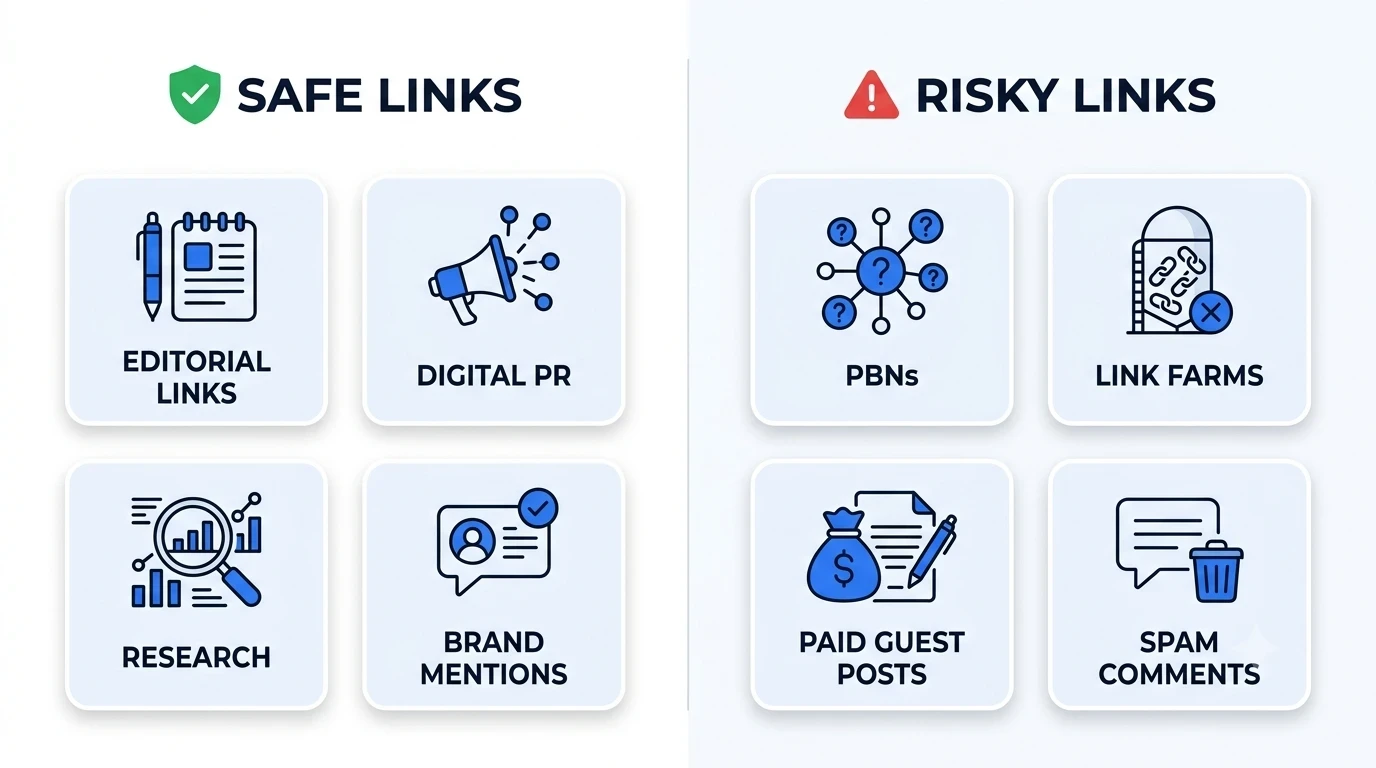
A link placed on a network site by someone who has never read your content and is being paid to include your anchor text; it fails the test regardless of how legitimate the host site looks on the surface.
Natural link acquisition correlates with external events: product launches, media coverage, content publication, and industry events. Acquisition velocity that follows these organic patterns, with bursts of links around newsworthy moments followed by gradual baseline accumulation, looks plausible.
Acquisition velocity that produces a consistent flat rate of 20 links per month for 18 months regardless of brand activity looks like a managed campaign rather than organic growth.
That velocity insight is one of the most actionable findings from studying sites that survived the updates intact. Organic link growth looks uneven. Managed link campaigns look unnervingly consistent.
What Link Building Actually Looks Like Now
Here’s the part most guides rush through or bury in vague advice. Let’s be specific.
Digital PR and Original Research
The link-building strategies that appeared most link-spam-free were the ones focused on building valuable informational content, proprietary data studies, and reports.
Original data gives journalists, bloggers, and industry publications something they actually want to cite. A survey, a case study, a dataset that doesn’t exist anywhere else. These are the assets that earn links without asking.
Data-driven digital PR campaigns are one of the most effective ways to get your brand into the content that large language models pull from.
Since AI systems used in Overviews and ChatGPT prefer fresh information, getting new data mentioned in press coverage positions you to appear more frequently in AI-generated answers as well.
Personalized Outreach Over Mass Email
Google and Yahoo introduced new email sender rules in 2024, making it harder for bulk outreach emails to reach inboxes. Spam detection has gotten smarter, filtering out generic link requests and mass outreach campaigns. Website owners are more skeptical of backlink requests than ever, making personalization a requirement rather than an option.
The outreach game hasn’t died. It has become much more selective. Sending 500 generic emails to get 5 responses is now a bad trade. Sending 30 highly personalized emails to exactly the right contacts, referencing something specific about their work and offering genuine value in exchange, still works very well.
Building Topical Authority Through Content Clusters
A link should match the theme of the website and the content it refers to. Machine learning algorithms evaluate relevance as one of the key trust signals. This means the context around your links matters as much as the links themselves.
Practical actions that support this:
- Build deep topical clusters so your site is recognized as a genuine authority in a specific space
- Target links from publications that cover your specific niche rather than general-purpose sites
- Make sure the linking content is topically related to the page being linked, not just the domain in general
- Prioritize branded anchor text alongside keyword anchors for a natural distribution
Brand Mentions and Unlinked Citations
Ahrefs’ analysis of 75,000 brands found that branded web mentions correlate with AI Overview visibility at 0.664, which is three times stronger than backlinks at 0.218 for AI search visibility specifically.
This doesn’t mean links don’t matter. Backlinks remain a confirmed ranking factor for Google’s traditional blue-link results, and the May 2024 Google leaks indicated that PageRank-style link signals are still in active use.
But it does mean that brand presence across the web, even without a clickable link, contributes to how both Google and AI systems evaluate your authority.
Getting mentioned on podcasts, in newsletters, in forum discussions, and across trade media builds the kind of entity recognition that supports your overall rankings picture.
Anchor Text Distribution in 2026
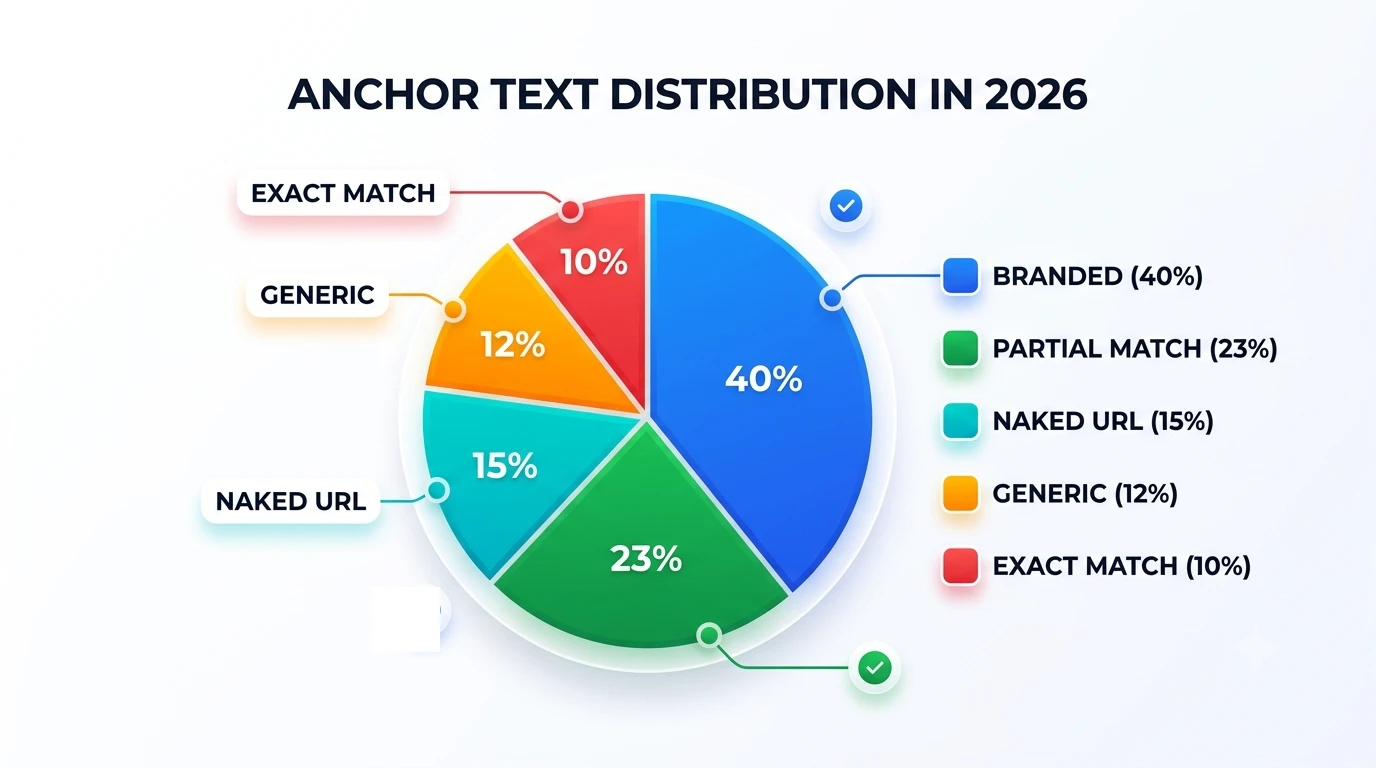
One of the clearest findings from studying sites that survived the update cycle is the role anchor text distribution plays.
In an analysis of 85 B2B SaaS domains that maintained or improved rankings through the 2024 to 2025 spam update cycle, every domain in the top quartile had branded anchors comprising at least 38% of their referring anchor profile. The bottom quartile averaged just 12% branded anchors, with exact-match commercial anchors exceeding 35%. That is a near-perfect inversion of the natural pattern.
A healthy anchor text profile in 2026 looks something like this:
- Branded anchors (your company or domain name): 35 to 50%
- Naked URLs (raw URL as anchor): 10 to 20%
- Generic anchors (“click here”, “read more”, “this article”): 10 to 15%
- Partial match or topical anchors: 15 to 25%
- Exact match commercial anchors: under 10%
If your profile looks like the inverse of this, heavy on exact matches and light on brands, that’s worth addressing as you build new links going forward.
Tactics That Are Effectively Dead
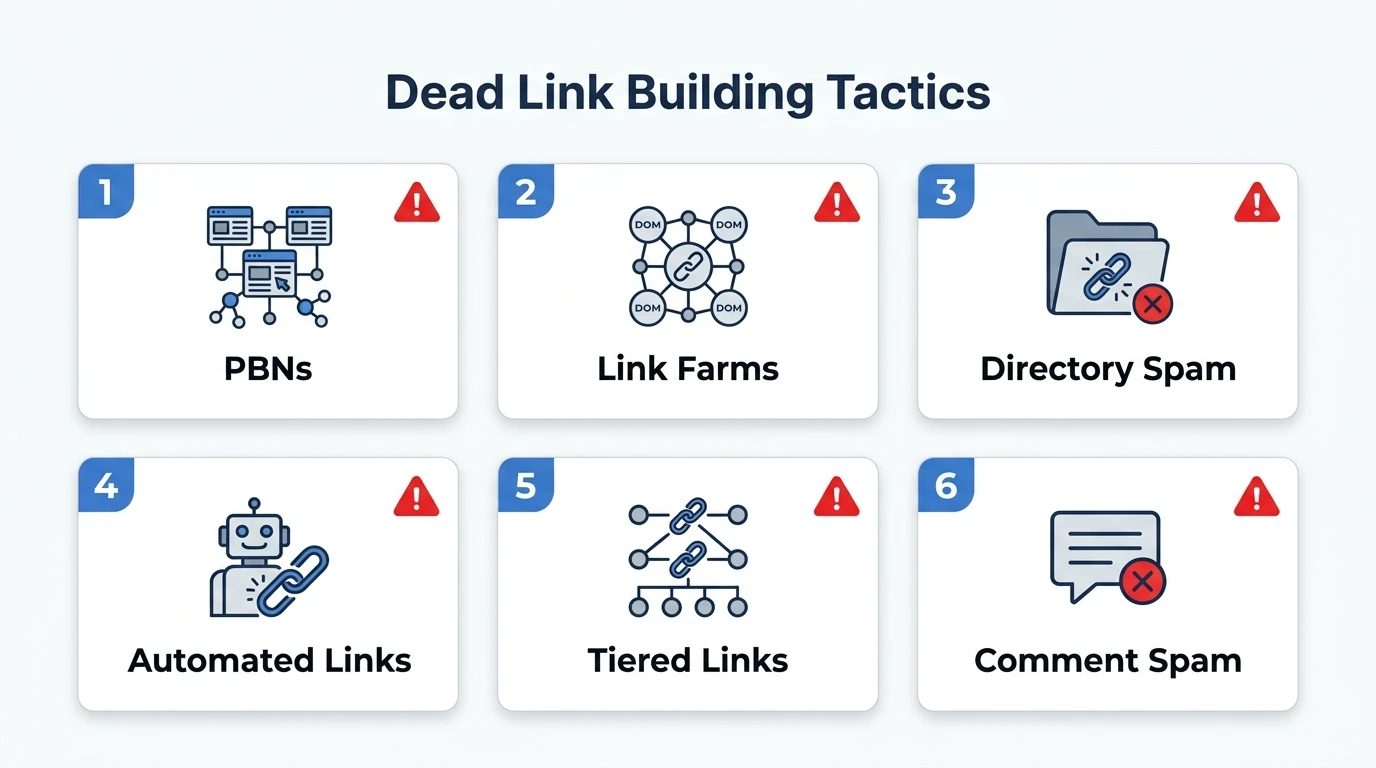
To save time and budget, here is a clear list of approaches that have been devalued enough to not be worth pursuing:
- PBN links: SpamBrain detects network patterns at scale. This is not worth the risk under any framing.
- Bulk guest posting through link marketplaces: The host sites lost their value when HCU hit them directly.
- Link farms: Large networks of low-quality websites created solely for exchanging or selling backlinks have also become ineffective under Google’s SpamBrain system.
- Comment links and forum profile links: Discounted for years and now actively flagged by SpamBrain.
- Automated link-building tools: Tools that promise thousands of links quickly are more harmful than helpful in Google’s current environment.
- Tiered link building: Building links to your links through networks compounds the risk without adding real value.
- Generic directory submissions at scale: Fine in small, relevant doses. Bulk submissions to unrelated directories are wasted effort.
The Mindset Shift That Actually Matters
Most of what changed in link building between 2022 and 2025 wasn’t really about tactics. It was about what link building is for. The old model treated links as a currency to be accumulated. More links meant more authority, which meant better rankings. The relationship was close to linear if you were willing to buy enough of them.
The new model is closer to how offline credibility actually works. A company that gets written about in the Wall Street Journal, cited in industry reports, referenced by respected voices in its field, and mentioned naturally when people discuss its category has earned something that can’t be replicated with a spreadsheet and a Fiverr order.
Getting the right links from the right places is what matters. SpamBrain tells Google to ignore and devalue links that follow manipulative patterns. Sites that were hit were not penalized in the traditional sense. It was a correction, a neutralization of the effect those spam links had been having.
That framing is actually helpful. Google isn’t punishing you for building links. It’s just getting better at making the shortcuts not work. The sites that thrive are the ones that were building links worth keeping in the first place.
Final Thoughts
The link spam updates didn’t make link building harder in the way most people think. They made low-effort link building worthless, which is genuinely different.
High-quality link building has always been time-consuming, relationship-driven, and tied to creating content worth referencing. The updates didn’t change that formula. They just removed the shortcut that let people skip it.
Stories that journalists, bloggers, and industry publishers actually want to cover will keep earning backlinks long after a campaign ends. That was true before SpamBrain, and it’s still true now. The difference is that in 2026, it’s the only kind of link building that reliably works.
Build something worth linking to. Get it in front of the right people. Let the links follow from that. That’s not a revolutionary insight. It’s just the only approach that Google’s improvements haven’t been able to devalue.
Frequently Asked Questions
Is link building still worth doing in 2026?
Yes, with an important distinction. Most link-building tactics from the 2010 to 2021 era are dead, including guest post networks, PBNs, directory spam, and comment links. But backlinks from genuinely authoritative, topically relevant sources remain a meaningful ranking signal. The practice is worth investing in. The old playbook is not.
If Google devalued my past links, can I get those rankings back?
This is the difficult reality: when Google’s systems remove the effects spammy links may have, any ranking benefit those links previously generated is lost and cannot be regained. Recovery comes from building better links going forward, not from trying to restore the value of links that have already been neutralized.
Are guest posts completely dead?
Not entirely. Guest posts on real editorial publications with genuine audiences and editorial standards still carry weight. What’s dead is the guest post network model, which means submitting articles to sites that exist purely to host paid placements with no real readership. The quality of the host publication and the relevance of the content are what determine whether a guest post link still has value.
How does the Google API leak change how we think about links?
The 2024 Google API leak revealed that Google tracks and scores links differently than what they publicly admit, that brand mentions without links may be just as valuable as actual backlinks in some contexts, and that Google considers link velocity and penalizes unnatural spikes as a real signal. The leak confirmed the direction many experienced SEOs were already moving: quality and authenticity over volume.
What’s the safest link-building approach for a site that was previously hit?
Focus entirely on editorial link earning through content worth citing. Original research, data studies, authoritative guides, tools, and resources that journalists and bloggers naturally reference. Rebuild your anchor text distribution toward branded and partial-match anchors. Do not try to accelerate recovery by purchasing links, as this compounds the original problem.
Do nofollow or sponsored links from quality sources help at all?
Yes, in two meaningful ways. First, a diverse link profile that includes nofollow links looks more natural than one composed entirely of follow links, which is itself a signal of authenticity. Second, nofollow links from genuinely high-traffic, high-authority publications can still drive real referral traffic, brand awareness, and the kind of entity recognition that contributes to rankings indirectly.
How important is the relevance of the linking site versus its domain authority?
Relevance has become significantly more important. Machine learning algorithms evaluate relevance as one of the key trust signals, and a link should match the theme of the website and the content it refers to. A DR 40 link from a directly relevant industry publication will outperform a DR 80 link from a completely unrelated niche in virtually every case that matters.
What should my link-building strategy actually focus on month to month?
Think in terms of assets and relationships rather than link counts. Create one genuinely original piece of research or data-driven content per quarter that journalists can cite. Build relationships with 10 to 15 relevant publications through consistent value, including sharing their content, contributing insights to their coverage, and being a reliable source. Pursue digital PR opportunities tied to news cycles in your industry. Monitor your anchor text distribution monthly and course-correct if exact-match percentages are climbing. That cadence, sustained over 12 months, produces a healthier profile than any volume-based approach.