
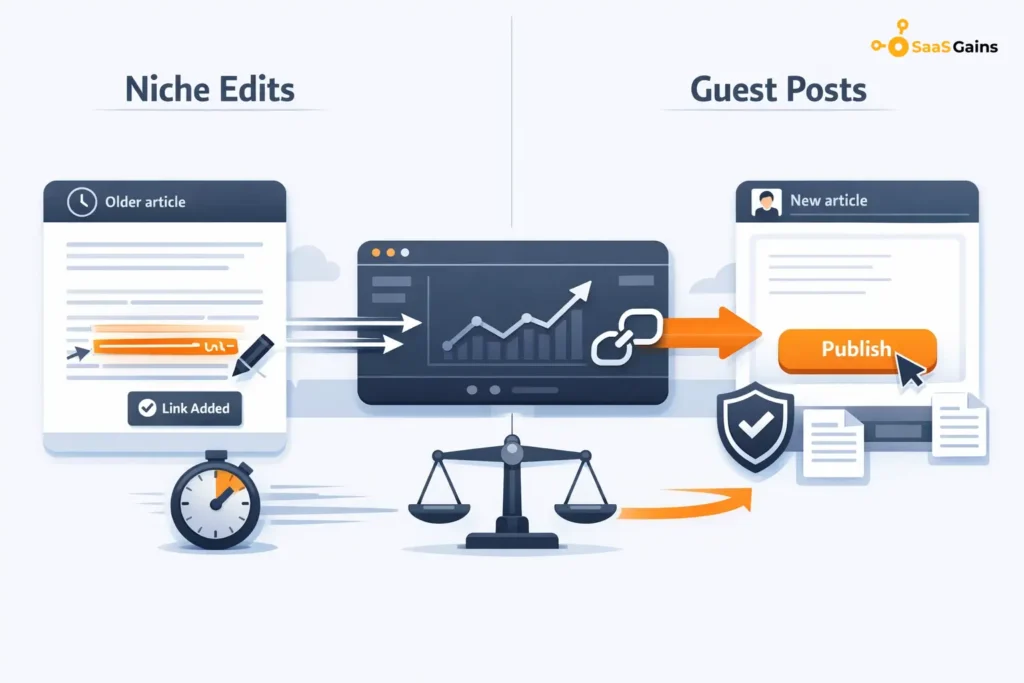
Building a backlink profile that actually moves the needle in search results is one of the biggest challenges in SEO. When you start looking for high-quality ways to improve your authority, the debate usually comes down to two main methods: guest posting vs. niche edits.
Both strategies have the same goal: getting a contextual link from a reputable website to yours. However, the way they achieve this is completely different. One relies on creating something brand new, while the other capitalizes on what is already working.
In this detailed guide, we will compare niche edits vs. guest post strategies to help you decide which one fits your current SEO goals, budget, and timeline.
Understanding the Basics: Guest Posts vs Niche Edits
To make the right choice, you first need to understand the fundamental difference between these two types of contextual backlinks.
What is guest posting?
Guest posting involves reaching out to a website in your niche and offering to write a unique article for them. In exchange for providing free, high-quality content, the site owner allows you to include a link back to your website within the body of the article.
What are niche edits?
Niche edit links, also known as curated links or link insertions, are added to existing articles. Instead of writing a new post, you find an article that is already live, indexed, and ranking on Google. You then contact the site owner to see if they will add your link into a relevant paragraph in that existing content.
The Pros and Cons of Guest Posting
When looking at guest posts vs. niche edits, guest posting is often seen as the more “traditional” way to build links. It has been a staple of SEO for over a decade.

The Advantages
- Complete Creative Control: Since you are writing the article, you decide the tone, the length, and exactly how the link is introduced.
- Brand Authority: Guest posts often include an author bio. This helps put your name and face in front of a new audience, establishing you as an industry expert.
- Fresh Signals: Search engines love “freshness.” A brand-new page on a high-authority site sends a strong signal to Google that your brand is being discussed in current conversations.
The Disadvantages
- High Resource Cost: You have to spend time or money creating a 1,000+ word article that meets the host site’s editorial standards.
- Slow Results: It takes time for a new page to be indexed and for the link to gain “power” in the eyes of search engines.
- Higher Rejection Rates: Top-tier blogs are flooded with guest pitches and are often very picky about what they publish.
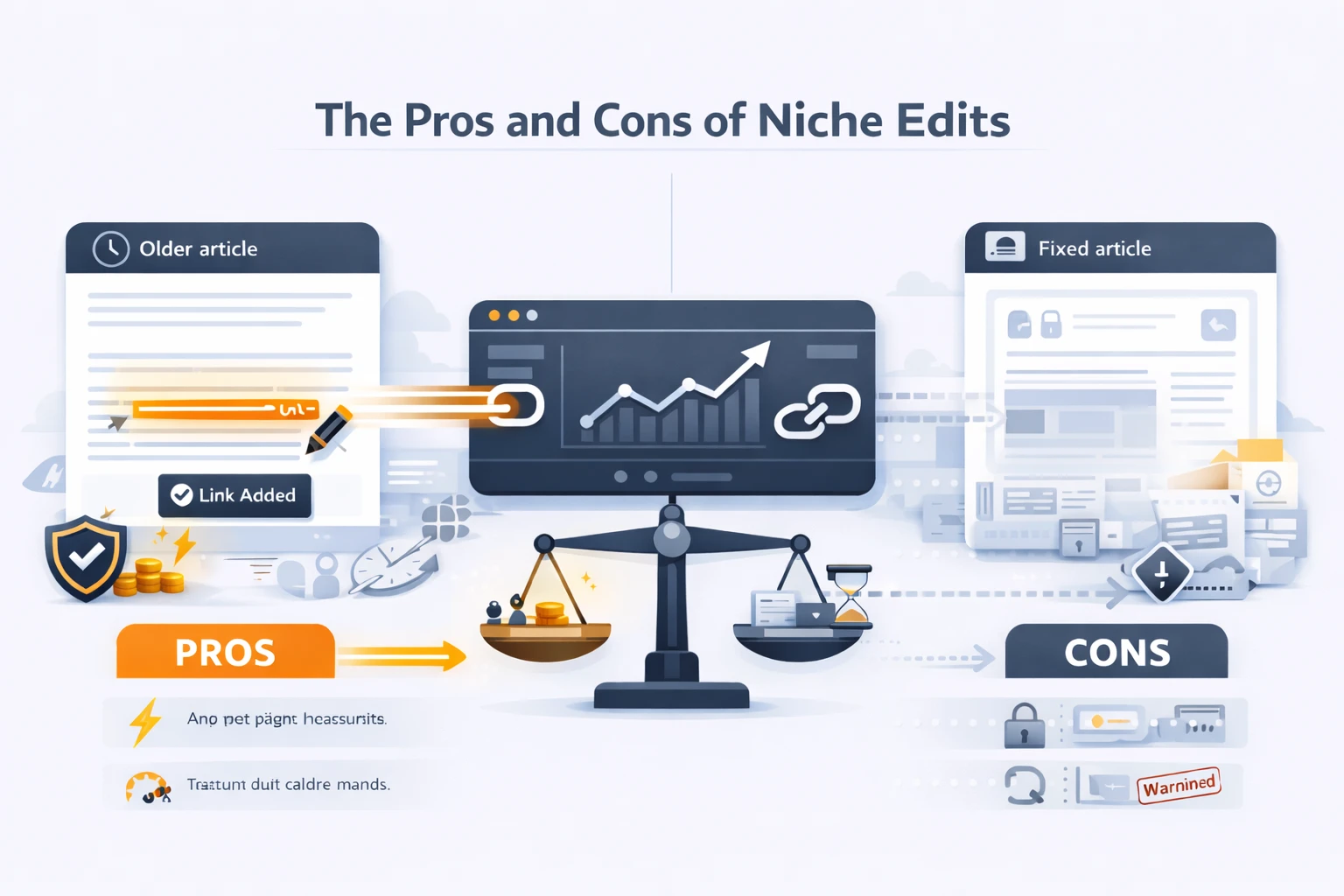
The Pros and Cons of Niche Edits
Many SEO professionals are shifting their focus to niche edit links vs. guest posts because of the efficiency and immediate impact of the former.
The Advantages
- Instant Power: The biggest benefit of a niche edit vs. a guest post is that the link is placed on an “aged” page. These pages already have their own backlinks and authority, which pass to you immediately.
- Existing Traffic: Niche edits are placed in articles that people are already reading. This can lead to instant referral traffic to your site.
- No Content Creation: You don’t need to hire writers or spend hours drafting new posts. You just need a high-quality destination page on your site to link to.
The Disadvantages
- Limited Context: You have to fit your link into a story that has already been told. You can’t change the entire article to fit your needs.
- Less Branding: There is usually no author bio or “shoutout” for your brand. The link is simply part of the resources or further reading within the text.
- Risk of “Dead” Pages: If you choose a page that hasn’t been updated in years and has no traffic, the link won’t be nearly as effective.
How to Choose Between Niche Edits and Guest Posts?
Learning how to choose between niche edits and guest posts depends on where your website is in its journey. There is no one-size-fits-all answer, but here are some guidelines.
When to Prioritize Guest Posting
- New Websites: if your site is brand new, you need to establish “trust.” Guest posts on high-authority sites prove to Google that your brand is legitimate.
- Branding Goals: If you want people to recognize your name as an expert, guest posting is the way to go.
- Complex Topics: If your product or service needs a lot of explanation, a full guest article allows you the space to educate the reader before they click the link.
When to Prioritize Niche Edits
- Ranking “Push”: If you have a page sitting on page two of Google and you want to push it to page one quickly, niche edits are often more effective because of their built-in authority.
- Tight Budgets: If you can’t afford to pay for high-end content writers and placement fees, niche edits are generally more cost-effective.
- Scaling Fast: It is much easier to secure 10 niche edits in a week than it is to write and publish 10 high-quality guest posts.
Comparison Table: Niche Edits vs Guest Post
| Feature | Guest Posting | Niche Edits |
| Effort Level | High (Writing + Outreach) | Medium (Outreach only) |
| Speed of Impact | Slow (Weeks to Months) | Fast (Days to Weeks) |
| Link Placement | New Page | Existing, Aged Page |
| Editorial Control | Full Control | Limited to existing text |
| Traffic Potential | Long-term growth | Immediate referral traffic |
| Content Cost | $50 – $200 per article | $0 |
5 Practical Examples of Each Strategy
Understanding the theory is good, but seeing how to apply niche edits vs. guest post strategies in real life is better.
Guest Posting Scenarios
- The Expert Guide: A financial advisor writes a 2,500-word “Guide to 2026 Tax Planning” for a major business magazine.
- The case study: A SaaS company shares a “How we helped Company X grow 300%” story on an industry blog.
- The Tutorial: A makeup artist creates a “Step-by-Step Summer Look” for a beauty publication.
- The Interview: You conduct an interview with a thought leader and publish it on a high-traffic niche site.
- The Trend Report: You analyze current market data and write a “State of the Industry” post for a news outlet.
Niche Edit Scenarios
- The Resource Update: You find a “Top 10 Tools for SEO” post from 2024 and ask the editor to add your new tool to the list.
- The Fact-Check: You find a blog post with an old statistic and offer your new, updated research as a replacement link.
- The Definition Link: You find an article that mentions “blockchain” but doesn’t explain it. You offer your “Blockchain Explained” guide as a helpful link for their readers.
- The Broken Link Replacement: You find a dead link in a popular article and suggest your own live page as the perfect substitute.
- The “Mention” Insertion: You find a blog post talking about your industry and ask the author to add a “For more information, check out [Your Site]” line.
Key Metrics to Watch for Both Strategies
Regardless of whether you choose guest posting vs niche edits, the quality of the linking site is what matters most. In 2026, search engines are smarter than ever, so you must look at:
- Topical Relevance: Does the site actually cover your niche? A link from a car site to a cooking blog is a red flag.
- Organic Traffic: Use a backlink checker to ensure the site actually has visitors. If Google doesn’t send them traffic, their link won’t help you much.
- Link Health: Does the site link out to every spammy site on the web? If so, stay away. You want links from “clean” neighborhoods.
- Engagement: Do people comment on their posts? Do they share them on social media? Real engagement is a sign of a real, powerful website.
Key Takeaways
- Diversify Your Profile: Don’t just pick one. A natural link profile should contain both guest posts and niche edits.
- Prioritize Relevance over DA: A “Domain Authority” of 30 that is perfectly related to your niche is better than a DA of 70 that has nothing to do with you.
- Content Still Matters: Even with a niche edit, the link needs to make sense. If it feels forced, users won’t click, and search engines might ignore it.
- Be Patient: SEO is a marathon. Whether you use niche edit links vs. guest posts, real results take time to stabilize.
Conclusion
The battle of niche edits vs. guest posts doesn’t have a single winner because both serve different purposes. Guest posting is the gold standard for building a brand, establishing authority, and controlling your message. On the other hand, niche edits are the most efficient way to boost your rankings quickly by tapping into existing “link juice.”
If you are looking for long-term growth and industry respect, invest in guest posting. If you need to move the needle on your keyword rankings right now, niche edits are your best friend. For the best results, use a combination of both to build a backlink profile that is strong, diverse, and ready to rank.
FAQs
Which is better for SEO, guest posts or niche edits?
Neither is “better” overall; guest posts build brand trust, while niche edits provide faster ranking power from aged pages.
Are niche edits safe?
Yes, as long as they are done through manual outreach to high-quality, relevant websites and aren’t “hacked” links.
How do I find guest posting opportunities?
You can use search operators like “write for us” + [your niche] or analyze where your competitors are guest posting.
Do niche edits cost more than guest posts?
Generally, niche edits are cheaper because you don’t have to pay for content creation, but high-authority site owners still charge placement fees.
Can I use the same anchor text for niche edits and guest posts?
It is safer to vary your anchor text. Use branded or generic anchors for guest posts and more descriptive, keyword-rich anchors for niche edits.